

 Filter by Popular Categories
 Filter by Popular Categories
Transition
Toolkit
STAGE 1: Setting Your Vision
- ON THIS PAGE
- Embracing the Cycle of Change
- To Future Generations: Legacy Letters
- Considerations: Current Farmer
- Considerations: Entering Farmer
- Finding a Successor
- Building a Common Vision: Communication and Relationships
- Related Tools
Embracing the Cycle of Change
Transition is an opportunity for transformation, and transformation is an inherently creative process. This is a time to think big, assess opportunities, and address challenges. It’s helpful to keep in mind that change is inevitable: one way or another, the years pass, and people come and go.
There are many changes we have no control over; what we can control is how we embrace change, how we choose to see change as an opportunity to pass on what is of value to us, and leave what no longer serves us by the wayside. The most important things that current farmers can pass on – beyond, of course, the land and farm business – are your wisdom and your ideas, your way of being in the world.
Just like the ecosystems that we work with, farms and businesses have life cycles. There are phases of new beginnings, growth, abundance, disturbance, and even death. Healthy farms ebb and flow through a cycle that allows for adaptation. Here’s one way to think about change and the transition process that can help inform vision setting for both current and entering farmers(1):
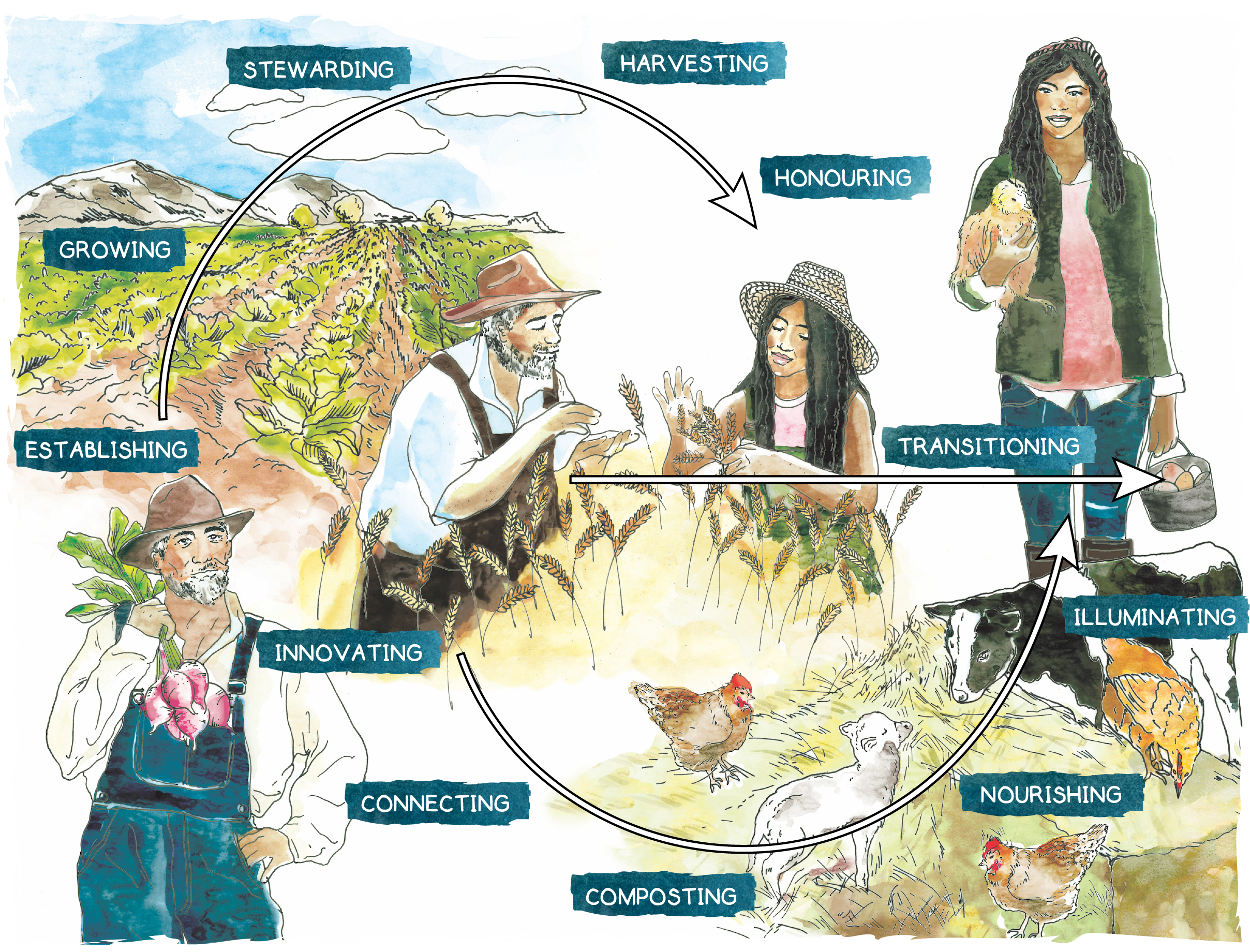
- Establishing: the start-up phase, creating both physical and business structures on the farm, setting up the patterns of who does what.
- Growing: investing, taking new opportunities, finding markets, establishing enterprises, building relationships.
- Stewarding: maintaining the business, carrying out routines, a feeling of “this is the way we do things around here” (which isn’t necessarily a good or bad thing).
- Innovating: entering farmer comes along, may be exploring new ideas, feels that “another way is possible” (which also isn’t necessarily a good or bad thing).
- Connecting: as they explore new ways of doing things, entering farmer connects with others, builds a network of support.
- Nourishing: entering farmer is gaining skills, testing, gaining experience, exploring the resources required.
- Illuminating: entering farmer and current farmer start making it real, they are planning and laying out the future together.
There are a number of other crucial dynamics that need to be thought about in transition:
- Composting: the resources, assets of the old business or farm are redeployed into the new one.
- Harvesting: learning from the way the land and business have been managed, learning from the previous generations.
- Honouring: honouring the current/previous generation, the business and the farm for what it has been and what it has given to future generations.
- Transitioning: bringing everyone along, making sure everyone is engaged in this new way of doing things, taking on new roles (current farmer becomes mentor, entering farmer becomes decision-maker).
ACTIVITY
Reflect on what you’ve learned so far by asking yourself the following questions:
- Where do you see yourself on this diagram?
- What has your experience been?
- Where do you see yourself moving to?
- Besides the assets and the business, what do you want to pass on to the entering farmer? What would you want to have passed on to you?
- What don’t you want to pass on? What don’t you want passed on to you?
- What skills do you think are needed for a successful transition?
- What value and skills can you bring to the transition process?
- What skills are missing from the transition team that will provide support?
- What areas do you want to work on?
- What areas do you need help with, possibly bringing in advisors?
Reference
(1) Adapted from the Berkana Institute Two Loop Model, Art of Hosting
To Future Generations: Legacy Letters
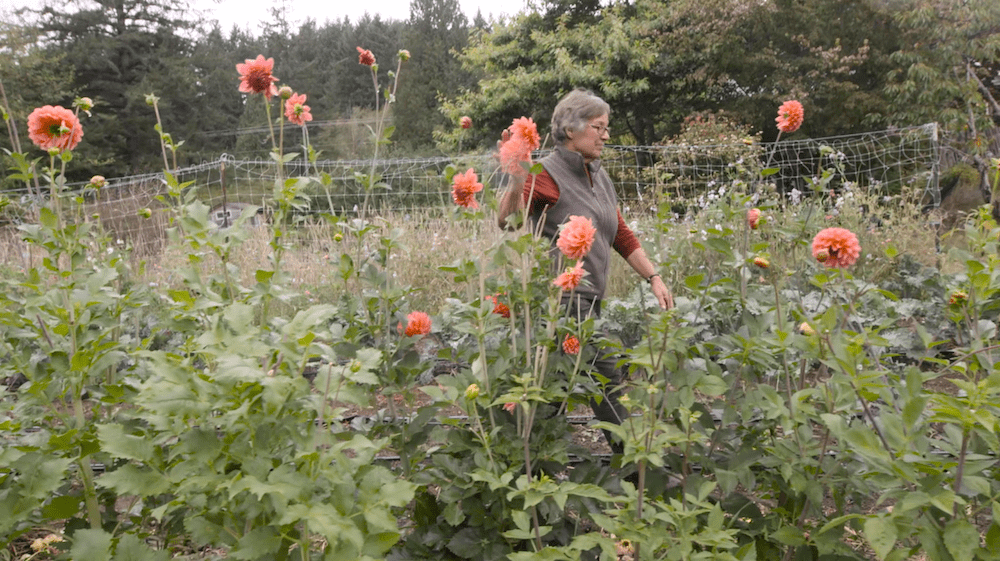
We asked farmers from around the province to share with us their vision for the future of their land and farms in the form of Legacy Letters. Read excerpts below and click to read each farmer’s full letter to future generations.
At the end of this section, you’ll find links to download the Legacy Letter tool. Take some time to reflect and draft your own Legacy Letter. This letter can be something you keep for yourself or something you share with your family and others involved in your transition. If you would like to share your letter with us, we would love to publish your letter so others can get inspired by your farm journey!
“We need to treat our agricultural land as a gift to be shared with the community for our lifetime and then moved on to the next generation for them to grow their food, teach themselves to farm and their children to farm, try out new farming methods and celebrate locally produced food with people in their neighbourhood.” – Lorne & Barbara Ebell, Nanoose Edibles Farm, Nanoose Bay BC
“My highest priority for the farm is to continue to be an organic vegetable, berry, fruit and nut farm that feeds the local community. We have been successful for the last 29 years selling healthy food locally despite the challenges of farming, and have strong connections in the community. There is no greater joy than seeing the delight on children’s and their parents’ faces as they eat a field-ripened strawberry or munch a fresh carrot.” – Rob Hettler, Pilgrims’ Produce Farm, Armstrong BC
Download the Legacy Letter Template:
This growing collection of Legacy Letters was inspired by the Practical Farmers of Iowa and adapted for the YA Transition Toolkit with gratitude. Practical Farmers of Iowa has helped more than 50 members write these letters. In the fall 2017, the University of Iowa Press published more than 25 of them in The Future of Family Farms: Practical Farmers’ Legacy Letter Project.
Considerations: Current Farmer
There are many pathways for current farms transferring a farm business and/or land to an entering farmer, depending on your vision for finances, your family legacy and what you want to see happen to the land in the future.
Different scenarios will offer different levels of financial compensation, and may offer different levels of security in knowing that the land will continue to be farmed into the future. Understanding your vision and needs will help you choose a pathway. Ultimately, your vision will be shaped by what you want your retirement lifestyle to look like, your finances, your family, and the legacy you want to leave for the future.
WEALTH MANAGEMENT: Retirement and financial needs are at the heart of transition planning. Owning land is a valuable asset, as the land can be sold to fund retirement. For many farmers, a land sale will be the main source of retirement income. It’s important to understand what you want your retirement lifestyle to look like, what funds you’ll need, and how important a family financial legacy is to you so you can develop a transition plan that meets those needs at this crucial stage of life.
Selling the land, and/or farm business, at market value, whether to an individual or a community group, offers the highest level of financial return to you. If a high financial return is not your priority, selling the land below market value or donating the land can create opportunities for young farmers.
STAYING ON THE LAND: There are few things as heartbreaking as pouring decades into nurturing a piece of land, only be forced to move away from that land when you retire. Many current farmers want to stay on their land after someone takes over the farm business, and there are a number of options to achieve this. The exact mechanism for staying on the land will be different depending on the transition model that fits your needs. It’s important to consider what housing is available on the land and what changes may need to be made to accommodate both current and entering farmers.
PRESERVATION OF FARMLAND: For many current farmers, ensuring that their land continues to be farmed is a primary goal for any exit strategy from the farm. This is a key driver that leads farmers to look at alternatives to putting the land on the market. If long-term farm use is at the core of your vision for the future, the ecological and social value of the land may feel more important than the financial value.
QUESTIONS TO ASK YOURSELF:
- What do you want your retirement to look like?
- What is your timeline for retiring from farming?
- What does retirement mean to you and your relationship to the farm going forward?
- What are your financial needs in order to retire from farming?
- Where is your retirement income coming from?
- What are your living expenses? How will those change over time?
- Do you have a financial cushion for unexpected expenses?
- Where do you want to live in retirement? Will this require you to purchase real estate?
- What income do you need from the farm? What other ways could you create income?
- What assets will you leave to the entering farmer? To your family? What will you sell?
- How will the farm transition affect the profitability of the farm?
- What elements of the farm culture (e.g. traditions, division of labour, ideals, values) do you want to pass on to the next generation? What don’t you want to pass on?
- How do you want the land to be stewarded in the future? Should certain areas be restored and/or protected?
- What elements of your legacy on the farm are most important to you?
- How will you communicate with the next generation of farmers?
- What is your conflict resolution style?
- How involved do you want to be in the management of the farm once you retire? How might that change with time?
- How do you want to commemorate the history of this farm?
- How do you want to spend your time on or off the farm when you retire?
- Do you want to spend time on the farm when you retire? If so, which parts of the farm would you like to access?
ESTATE PLANNING & FAMILY LEGACY: Inheritance is often a sticking point in family transitions, where one heir wants to farm and the off-farm heirs expect their “fair share” of the financial legacy. In non-family transition, this is even more complex! The question becomes, how do you balance leaving something for your heirs while passing on the farm outside of the family?
Off-farm heirs might be counting on an inheritance to get themselves set up in the world, and many parents want to provide that to their children. Many children of farmers don’t go into farming themselves, but cherish memories of growing up on the farm and feel a close connection to the land.
Any transition plan should consider how the family may want to remain involved in the farm for the future. In one example, Lohbrunner Farm on Vancouver Island is held in a land trust and managed by a farm co-operative, but the children of the previous farmers retain the right to visit the farm. This allows them to stay connected to their family legacy without having to manage the farm business.
Engaging the whole family early in the process is essential to ensuring that everyone has had the opportunity to share their voice. Everyone impacted by a transition plan should be on board with the result to avoid future complications, such as children contesting a will. Mediators can be helpful to ensure everyone’s voice is heard while navigating these conversations. Counselling after mediation is recommended to overcome potential feelings of loss or not living up to expectations.
QUESTIONS TO ASK YOURSELF:
- What values do you hold as a family around the farm? What do your children want to see happen to the farm in the future? What do they think about your vision?
- What role do they see themselves having related to the farm in the future?
- What are the needs of your heirs? Do they need a financial benefit? Legacy access to the land? Will your children inherit the land, but not the farm business? If so, what would they do with the land, and how would that impact the farm business?
- What is equitable? This might not be the same thing as equal.
- What are the off-farm assets (e.g. life insurance, RRSPs, investments)?
TAXES: Whenever selling land or a business, there will be tax implications. Consult with qualified advisors to ensure you are structuring deals advantageously. There are detailed sections on Capital Gains and Property Transfer Tax in Appendix A of this toolkit. Here are a few important tax considerations for current famers:
- Some of the tax provisions require that planning to make use of such provisions be done early. For example, the ability to have a property as a Qualified Farm Property has specific stipulations that may need to be in place for a number of years, which need to be planned for.
- When selling property, you may qualify for the lifetime capital gains exemption, which currently exempts up to $1 million of capital gains for qualified farm property (the amount of the exemption is subject to government regulation changes).
- Careful planning several years in advance of a sale may enable using the capital gains exemptions of other family members (e.g. spouse).
- To claim the Capital Gains exemption, the sale and exemption must be reported in the tax return. Failing to report the disposition can result in loss of the exemption and the sale could be fully taxable as an ordinary capital gain.
- Estate planning should happen early and deal with the full implications of taxes due upon death. Sometimes simple planning can help alleviate unnecessary taxes upon transition.
- Probate fees possibly apply if ownership of the land is transferred through a will (as opposed to a transfer in the current farmer’s lifetime). In 2020, probate fees were 1.4% in B.C.
- Property Transfer Tax potentially applies, unless a family farm exemption provides relief.
- Some current farmers are interested in sharing ownership of the land with an entering farmer and adding the entering farmer to the title. Adding someone who is not a family member to the title means that Property Transfer Tax would be due based on the percentage of ownership.
- The death of a farm owner may trigger a liquidity event in which a tax liability is created that may be avoided with timely planning. This will enhance the likelihood of keeping a farm property in the family, as property will not have to be sold to fund tax liabilities.
- See Appendix A for details on Capital Gains and Property Transfer Tax.
Considerations: Entering Farmer
As an entering farmer considering a transition plan, there is much to think about: your current lifestyle, farm business management skills, financial capacity, and plans for the future. Your pathway will be shaped both by things outside of your control, such as land prices, and choices you make, especially around your lifestyle. The land base is important, but is only one element of a farm business plan. Clarifying your vision and needs will help you understand what farm transfer model might fit.
The bottom line is that a farm business needs to be financially viable. Examine the type of farm you want to run, its financial status and potential to expand, as well as your capacity to take over a farm. Joining an existing farm business often means revenues that support one farm family now need to support two or more.
As you look inward at your own skills and capacity, you may want to deepen your business management skills. Young Agrarians, Farm Management Canada, and the B.C. Ministry of Agriculture, among others, offer programs and educational resources to help you build these skills. Identify areas you want to strengthen and map out a pathway to gaining those skills over time.
QUESTIONS TO ASK YOURSELF:
- How do you define farm business viability?
- Do you have a strategic mindset to help guide the farm towards continued success?
- Do you have the necessary skills and experience to take over the farm?
- Do you have the right people supporting you?
- What is your leadership style? Do you have the leadership capacity to make sound management decisions and lead the team?
- What do you envision for the future of the farm, and how will you get there?
- What are the risks involved, and do you have measures in place to mitigate these risks?
- What will your relationship with the current farmers be, as the future unfolds?
- Are there critical timelines to consider for achieving transition and transfer milestones?
- What elements of the farm culture (e.g. traditions, division of labour, ideals, values) do you want to keep from the current farmer, and what do you want to let go of?
- How do you want to steward the land? Should certain areas be restored and/or protected?
- How will you communicate with the previous generation of farmers?
- What is your conflict resolution style?
- How do you want to commemorate the history of the farm?
LAND: TO OWN OR NOT TO OWN?
It is important for entering farmers to understand what type of landholding model is the right fit. Do you want to own land? Share ownership with others? Or perhaps not own the land at all? Many new farmers would like to own land if it were possible, but let’s challenge the assumption that owning land is necessary to farm. If you don’t own land, you will probably lease it, whether from a private landholder or a community organization. Half of Canadian farmers under 35 lease land for their farm business, as do 35% of overall farms.(1) Many entrepreneurs don’t own the premises out of which they operate. When starting a restaurant, your first step likely wouldn’t be to buy the building, but to lease.
Because farming is a land-based business, much investment is in the land, soil and attached infrastructure. It’s not easy to pack up and move a farm. As well, owning land may help you access loans as the land gains equity and can be used as collateral. Land ownership also addresses core needs for safety and security; knowing there will be a roof over your head both this winter and when you retire.
There’s a retirement angle to owning land, too. Buying land now pays off in the long-term. Canada’s wealth management culture is geared towards people owning their home by retirement, at which point they can live mortgage-free or downsize, and maybe leave a legacy for their children.
So, should you own land or not? Only you – and your financial reality – can answer that question. Part of developing your vision and deciding which model best meets your needs is understanding your capacity for risk versus your desire for flexibility. When you don’t have access to capital, you may have to accept more risk. That said, risk can be a matter of perception.
If you choose a transition model with a path to land ownership, your hurdles will centre on financing, and finding suitable financial collaborators. If you opt for an alternative model where you don’t own land, you will need other mechanisms to provide the security and stability needed to both run your farm and plan for retirement.
When setting your goals, it’s helpful to focus not on the solutions (such as owning land) but on identifying the needs those solutions may address. Once you get at that underlying layer, you may see creative solutions. What if we look at the needs owning land seems to address through a different lens:
FINANCIAL CAPACITY: Your decision about owning land will ultimately be determined by your financial capacity: simply put, can you afford to buy land? Maybe you have family to help, you have savings, or you have off-farm income that will allow you to qualify for a mortgage.
WEALTH MANAGEMENT AND RETIREMENT PLANNING: Land ownership is not the only way to ensure you’ll have something to live off when you retire. In fact, it may not be a wise retirement strategy if you end up in a situation where you need to sell the land to access your retirement funds – when maybe you’d prefer to stay, or one day transition your farm and land to the next generation.
A wealth management expert can help you structure a diversified solution to build wealth based on your projected needs in retirement. Opening a Registered Retirement Savings Plan (RRSP) and a Tax-Free Savings Account (TSFA) is a step towards starting.
HOME SECURITY: Farming is unique among business models because home life is tightly woven with work life. Sometimes it’s hard to see where one ends and the other begins (that’s especially true of the work day, as many farmers will attest). A key consideration for current farmers in transition planning is where they will live, whether that means staying on the farm, or moving to a new home. In 30 or so years, you will be faced with the same questions, and thinking through your retirement now will help you plan for the future.
FLEXIBILITY: As a landholder, selling is an exit strategy when things aren’t going well, or external factors take you in a different direction. This is, of course, regionally dependent as some properties may be more attractive on the market than others. Selling is not always simple, quick, or even guaranteed. That said, it’s commonly accepted.
Leases can be structured so that they can be “assigned;” essentially, sold to a third party, who would then hold the lease and be the farmer. The difference between selling a property you own and selling a lease, is that when you sell a lease, the landholder must also approve of the person to whom you sell. It is customary to include a clause that approval cannot be unreasonably withheld, with the test being that the person coming into the lease be of equivalent abilitiy and financial standing.
Complexities aside, a long-term, secure lease can be transferred, and can have significant financial value. You may not immediately see dollar value in a lease the same way you can see dollar value in property for sale, but a lease is most certainly a valuable, if not commonly understood, asset. We encourage you to seek lease development support through the B.C. Land Matching Program or a lawyer to ensure your lease addresses all the relevant details.
BUSINESS SECURITY: There are plenty of stories out there about new farmers who lease land for a few seasons, and just as things are getting good – the soil is thriving, systems worked out, customer base built – the land is sold, and the farmer has to move their operation. There’s no way around that kind of heartbreak. There is risk if you don’t own the land, but well-designed leases can provide the kind of security needed for farmers to invest long-term. A registered lease “runs with the land,” meaning that if the land is sold, the lease continues in effect. A registered lease, coupled with a long duration, say 30 or 40 years, can provide long-term stability for a farm business. Even a 3-year or 10-year lease agreement provides a formal contract with a level of security.
ACCESS TO CAPITAL: One of the best arguments for owning land as a farmer is that it can make it easier to qualify for business loans – that said, first you have to qualify for a mortgage, and then you have to service that debt, which can be a lot to manage while transitioning into a farm.
Leases can also have value that can be leveraged to obtain financing, where a lender will see a lease as a type of collateral or security that will allow them to lend to you. A key consideration in leveraging a lease for financing is that the lease term must be longer than the amortization period for whatever it is you’re financing. If you purchased a tractor that would amortize over 10 years, your lease term would likely need to be 15 years.
You should have an idea of what financing you might need for your business in the future, and talk to a lender about how you can leverage a lease to obtain funding. Finding a lender you trust and building a solid relationship will help you plan for your farm’s financial future and put you in a better position for future borrowing needs or debt structuring. Keep in mind your accountability to that relationship in terms of meeting loan commitments.
QUESTIONS TO ASK YOURSELF:
- What are my current financial resources and needs?
- How capital-heavy is my business model? Will I need to depend heavily on financing?
- Will I need off-farm income (e.g. to purchase the land) or to sustain the business?
- How much money is needed from the farm for the current farmer’s retirement?
- How does my business plan measure against the current farmer’s financial needs? If it doesn’t balance out, what changes do I need to make?
- How much money will I need in retirement? How am I currently saving for retirement?
- Where can I live now? Where do I want to live when I retire?
Reference
(1) Statistics Canada. Table 32-10-0407-01 Tenure of land owned, leased, rented, crop-shared, used through other arrangements or used by others. doi.org/10.25318/3210040701-eng
Finding a Successor
You’ve decided you want to transition your farm to the next generation. You have a clear sense of your vision for the future – now you need to find the person, or people, to help you fulfill it.
TRANSITION ROLE: Attracting the right person will be easier if you understand your desired level of involvement as the transition progresses. What role do you want in the farm business, both short- and long-term? Some current farmers are ready to retire and move off the farm; others want to be more hands-on. This is a great moment to consider different possible roles: moving into an advisor role, helping with farm labour, actively mentoring the farmer in day-to-day operations, or setting up a board where you’re involved but not making business management decisions.
QUESTIONS TO ASK YOURSELF:
- How can you best contribute to the long-term success of the business?
- What fits best both the long-term needs of the farm, and your own personal needs?
- What will you realistically have capacity for (physically, time-wise, etc.)
- How will your role allow you to balance providing expertise with the entering farmer’s need for independence?
- How will your role evolve? You may be more involved initially and step back over time.
Next, it will help to understand what you’re looking for in a successor – the qualities and qualifications you’d like someone to bring to the table. What does your ideal entering farmer look like? Take the time now to write down ideas. Here’s a list of criteria that current farmers shared:
- Farming experience is a must! Farmers we spoke to found that prior experience was the #1 indicator that an employee would stick around. Farming is tough, and making it through a few seasons is a clear indicator that you have the skills and are committed to a farming career.
- Good communication skills and the ability to work through things with people.
- Shared philosophy, values, and stewardship practices.
- Financial resources.
- A good support system and community (did we mention farming is hard?).
- The capacity to be a strategic, visionary thinker and confidence to make crucial decisions.
- Flexibility and adaptability to respond to uncertainty, change and new opportunities.
- The right attitude: enthusiasm and passion!
You may find certain criteria may be a higher priority than others and some will be more needs-focussed versus desired. For example, if you have a livestock operation a successor will need to have experience pertinent to managing livestock. Skills related to social media marketing by contrast will be less important and be considered an asset but not a requirement.
WHAT ARE YOU OFFERING?
Now that you’ve got your vision – for yourself, your farm, your land and for the right successor – how you frame the opportunity will impact who comes to the table. Many current farmers want to be able to see if there’s a fit with potential entering farmers before committing to transition plans. This is a wise approach. That said, making the long-term potential clear will attract farmers who are looking for such opportunities. As well, how you frame the opportunity will depend on how involved you want to be and your retirement timeline.
Stage 3 of this guide explores different planning solutions, such as leasing, employment, and joint ventures. These solutions may help current farmers frame an opportunity with a concrete short-term offering (say, a farm manager job), while indicating that they are open to exploring longer term transition opportunities – for the right fit!
Some current farmers may be more interested in securing a successor and having a faster transition. In this case, the transition offering would be more direct and explicit. The more concrete your offering is, the more likely you’ll attract someone serious and qualified. Potential information to include:
What are the attributes of the land (e.g. size, zoning, water, soil, infrastructure)? See Site Assessment Checklist in the YA B.C. Land Access Guide for a full list.
- What is the history of the farm and land?
- What is the current farm business model?
- What is the current culture and values on the farm?
- What is your vision for the future and what could a long-term opportunity might look like? This could be quite different in a co-op farm vs a private enterprise.
- What qualifications are you looking for in potential entering farmers?
- What role will they have on the farm, and what are the expectations?
- What remuneration will be provided (room, board, wages, equity, etc.)?
- What resources should applicants have, and what level of commitment are you seeking?
UNDERSTANDING YOUR FARM’S BUSINESS VIABILITY
While you may not share this information far and wide, it is essential for current farmers to have a clear understanding of the current farm business operations and financial viability.
Detailed documentation of the current status of the operation will be valuable when talking to potential successors, and will be necessary for next steps. This could include a description of the current farm business, including products, markets, customer base, assets, any organizational charts or diagrams to visually explain/represent current land/business overlaps and details etc.
It is also important to consider how a transition plan will impact the financial picture of the farm. If assets are to be removed or additional loans required, the transition plan should be included in the overall goals and borrowing needs of the farm, so that debt can be structured, and cash flow maintained. Debt should be structured like investments, so that debt payments are staggered over years rather than piling up on one another. This also mitigates interest rate risk.
QUESTIONS TO ASK YOURSELF:
- Is your business viable? What does “viable” mean to you? How might this compare to definitions from others? What is your business “worth”?
- Is there an existing business plan? Does it need to be updated?
- Is the farm meeting its business goals? Is it profitable both now and in the long-term? If the answer is no, that’s okay, but you’ll need to work with an entering farmer to arrive at a mutual understanding of future viability and develop strategies to address any shortfall.
PUTTING A DOLLAR VALUE ON YOUR FARM BUSINESS: It can be hard to figure out the economic value of your farm business. However, understanding what the value of your business is will help entering farmers assess the opportunity, and help you negotiate fair terms to ensure your needs are met.
There are three main ways to figure out the fair value of a business, though other ways do exist. You can base fair value on 1) future earning potential, 2) on the sales value of similar businesses (if such information is available), or 3) on the business’ assets (after subtracting liabilities). It’s important to arrive at a valuation that feels fair to both parties. Farmers should always consult a professional for valuation. A qualified Chartered Business Valuator can value the business and provide a report.
WHERE ARE THE ENTERING FARMERS?
Now it’s time to put the word out and find your entering farmer match. Where are they now? How can you reach them? Maybe they’re already in your network – you know who they are but haven’t really started these conversations yet. One farmer we spoke to had been looking for someone to take over their poultry operation for a few years, before finally striking up a conversation with a neighbour who turned out to be the perfect fit. Maybe you have an excellent long-term employee who would be interested in solidifying their role for the future. You may have to reach further afield, using outreach opportunities in your community and online. Here are some suggestions:
- Community: let your community of farmers know you’re looking, use bulletin boards, local papers, etc., engage your local Farmers’ Institutes and Producer Associations.
- Events: go to Young Agrarians and other farm-related events to meet potential entering farmers and put the word out about what you’re looking for.
- Online web tools: YA land blogs, U-Map, Farmlink, listservs such as COABC, BC Urban Farmers, etc.
- B.C. Land Matching Program (BCLMP): Talk to a YA Land Matcher!
You have a successor! Now what? Once you’ve identified a successor, you can begin the transition planning process in earnest. While it’s essential to understand your vision, goals, and needs before seeking an entering farmer, for a transition plan to be successful it should ideally be co-created. This means both parties to the transition are actively engaged in developing a common vision and moving it forward. The next sections will explore starting the conversation, communications tools, and planning.
Building a Common Vision: Communication and Relationships
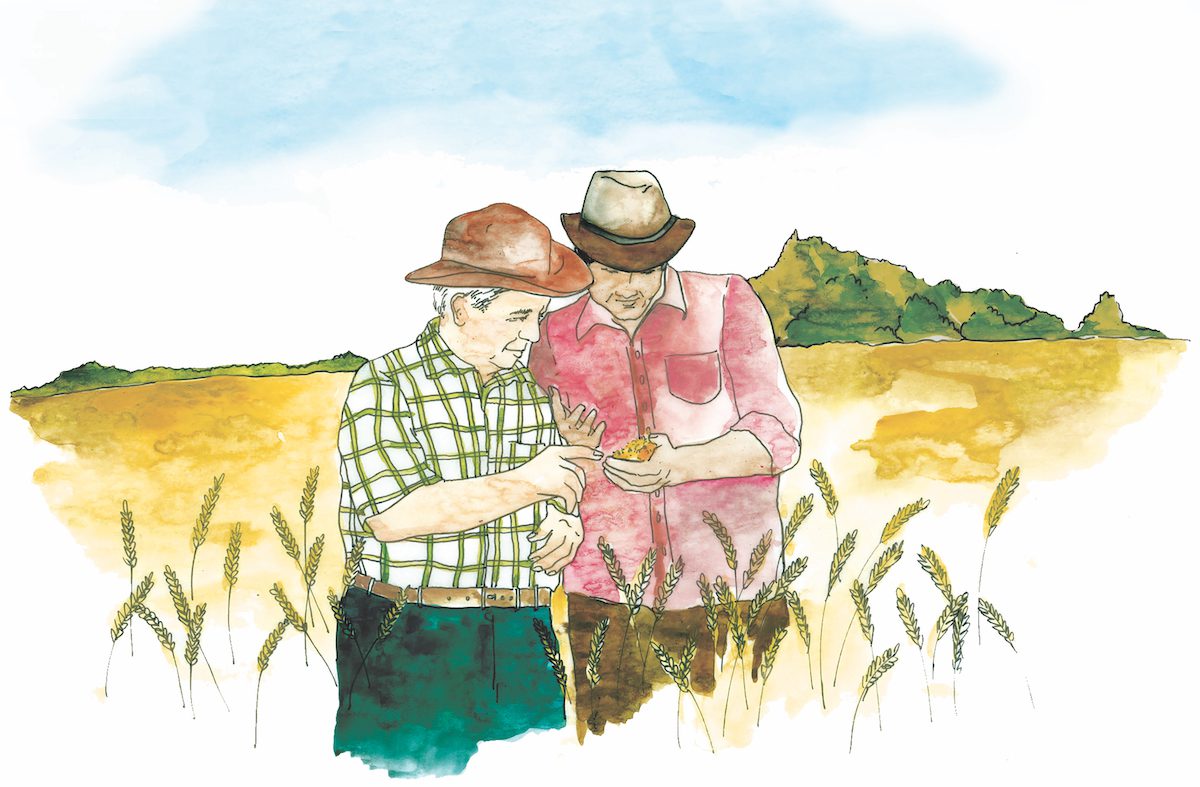
Farm transition could be described as one long series of conversations. Starting the conversation is hard, but there are many discussions that need to happen, which means there are lots of entry points. These conversations might happen at different times in different places. Lots of farmers aren’t used to formal meetings, so don’t be surprised if you have discussions while fixing machinery, driving through the pasture, or weeding a row of carrots. These conversations also don’t generally happen one at a time or in one moment. They evolve and build over time. The topics suggested here are conversations to have with those involved in the transition, directly and indirectly, as well as questions to ask yourself.
Once each person involved in a transition has a sense of your individual vision, it’s time to build a common vision. This means sharing your hopes and concerns with each other and getting to know your respective visions, so that you can see where there is alignment and where more discussion is needed. Remember, it can take a long time to get to know each other, especially for those outside of the family, but this can also be true if it is a family member that has been away from the farm for a while. This is all about setting the relational and communication foundations and sharing expectations, which doesn’t happen overnight. Once you understand each other’s needs, you can figure out solutions and develop your plan.
NAVIGATING CONVERSATIONS
In transition, everyone has a lot to learn. It’s easy to forget that this is the first time around for everyone involved. The learning curves are as huge for the current farmer as they are for the next generation in terms of how to support and mentor one another. We are all learners and teachers in this. You’re probably not going to get it right on the first try, and nothing is ever 100% perfect. Conflict will happen but with a good foundation, you can work through it.
CONVERSATION TIPS:
- Stay curious and listen deeply. What’s the difference between listening and waiting to talk? Work to understand those involved and how they came to think the way they do.
- We often think of conflict as ME vs. YOU. What if we shifted that to US vs. the ISSUE? What doors does that open to working on a problem together?
- Ask open ended questions. Open-ended, exploratory conversations help build trust.
- Clarify your assumptions. Ask, what did you mean when…?
- Consider and acknowledge the other’s perspective. Let them know you heard them by using phrases such as: Sounds like ____ is really important to you, did I get that right?
- Seek common ground to build trust/understanding and identify the interests. Ask, what do we both value here? What is your basic concern in wanting this…?
- Avoid going straight to solutions. Explore each person’s needs and what’s important to each person in a solution before brainstorming as a team.
- Stay committed! Many of these conversations will be hard to navigate. If you all feel committed to working through a transition it will be easier to be vulnerable and overcome potential conflict.
- Strive to always end on a good note, and take the time to build positive relationships outside of the transition conversations (share meals, weed the carrots together, etc.).
- Establish a structure. This means setting schedules for meetings and sticking to them! It also helps to create an agenda and provide an opportunity for input on the topics of discussion.
QUESTIONS TO ASK EACH OTHER:
- Big Picture: What drives you? What makes you come alive? What motivates you to get out of bed in the morning? What feeds your soul? What do you need to make your life meaningful?
- Intention: What drew you to this course of action? Why farming? What else would/could you be doing? Are you mentally, physically, economically, and socially prepared for farm life? What will have to change in your current lifestyle to move forward on this course?
- Situation & Context: What is the context? What is your sense of the situation? What’s currently working or not working? What questions do you have of everyone involved? What information do you need that would be helpful?
- Decision Making: Who are the decision makers? What roles/responsibilities does each person want to take on? Do they have the skills and, if not, how can they develop those skills? Who has veto power and over what? How are decisions made? What do we do when we don’t agree? What makes sense now? What do we want to move towards in the future?
- Planning: How would it work? How will it unfold over time? What would the relationship look like? What would the business and land agreement look like? What would be the overall plan?
- Working: What does the season-to-season, month-to-month, day-to-day look like? What resources do you bring/what do you need?
- Learning & Self-improvement: What would you need/want to learn to make this work? What skills do you bring to the transition? Where could you improve?
- Dispute Resolution: Differences of opinion are inevitable. Sometimes these are minor (“Where should we store this hose?”) and sometimes major (“We have different perceptions about the value of the farm business”). It’s essential to discuss what happens when a disagreement comes up so you have a plan for working through it together. Individual exercises can help you understand your communication style; share the results with each other so that you can better understand how to talk to each other effectively. For example, some people like to talk about disagreements as they happen, while others prefer to establish set meeting times to discuss things. Write down your dispute resolution process, including how you’ll handle day-to-day communications and what happens if you can’t solve a problem together: Will you bring in a mediator? Go to arbitration? Litigation?
RELATED TOOLS
- SETTING YOUR VISION PDF | Word document
- WRITE YOUR OWN LEGACY LETTER
- COMMUNICATIONS ASSESSMENT
U-Map Resources
A national interactive Resource Map focused on centralizing information for new and young farmers from farms in the network, to available land, financial resources, farm suppliers and more. Add your resource to the map or find a resource. If you are mapping resources in your area, please get in touch!
