

 Filter by Popular Categories
 Filter by Popular Categories

FEB 28-MAR 1, 2026: SNPINTKTN, PENTICTON, BC Mixer
Calling all farmers!
Young Agrarians (YA) invites you to join us to share knowledge and connect with each other towards growing the next generation of farmers.
YA (un)conference-style Mixers are a great opportunity to support and connect with passionate new and young farmers in the YA network.
Threads woven through the weekend include sustainable business management, ecological and regenerative production, farmer health and wrap-around-care, policy change and Indigenous food sovereignty.
YA mixers are known for the remarkable connections made: new possibilities for collaboration, support, sharing and cooperation. To make the most of this, come with an openness to meet new people, share something that you have to offer (like employment, land or special skills) and something that you might need (such as specific tools, crop planning models or mentorship).
THEME: The theme of the mixer is “Resilience in Relationships” – a gesture towards the interconnections that sustain us, with the land and each other. Resilience is the work of a community, not an individual, and relationships bring us out of isolation and into connection. Resilience can be very practical – and this Mixer event seeks to connect us all better to skills, resources, practices and supports in a networked approach to navigate change together.
WHEN: Saturday, February 28, 8:30am-9pm and Sunday, March 1, 2026, 8:30am-4:30pm
WHERE: This two-day event will be held in snpintktn, at the Okanagan College Campus of Penticton: 583 Duncan Ave W PC 256, Penticton, BC V2A 8E1
REGISTER: Please register on Eventbrite to reserve your spot.
COST: Sliding scale – suggested $40 – $120, with free tickets for people who face systemic economic barriers as members of racialized communities such as Indigenous people, Black people and People of Colour. All funds raised go to covering the cost of the event. If you feel resourced to, please choose the higher ticket end, and know you are supporting others in attending who face barriers to access. If you are facing other barriers to accessing this space, please get in touch. No one will be turned away for lack of funds. Please let us know your needs at bc@youngagrarians.org.
POTLUCK LUNCHES: We are welcoming potluck lunch for this event, for both days. Please bring an item with you to share for 10-20 people, and please write ingredients on a card to place beside your offering. Breakfasts, snacks and dinner will be covered, and will feature produce from local farms. Menu to be shared closer to date. If you are a farmer who would like to donate some produce you have grown and/or preserved, we’d love to hear from you and feature you and your farm on our menu!
ACCOMMODATION: Accommodation is not included in the ticket price. Please arrange your own accommodation. Group rates will be available at the nearby Fairfield by Marriott Inn & Suites Penticton – more information coming soon, please keep an eye out here!
Have a spare room or couch to share in snpintktn/Penticton? Looking for space to stay in town? Post in the Facebook Event discussion to coordinate.
CARPOOLING: Folks will be travelling from all corners of B.C. and beyond to attend. If you are looking for or can offer a ride to or from the event, please post in the Facebook Event discussion to connect with others.
SCHEDULE: Subject to change. Please see updates below!
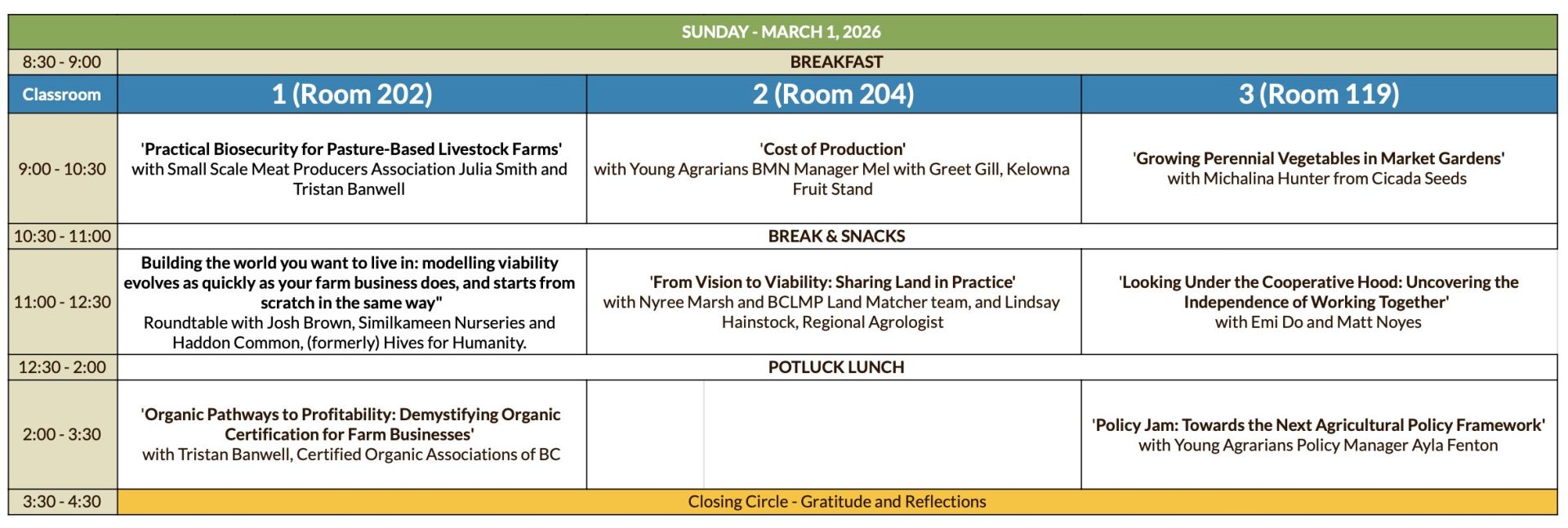
About the Sessions
Indigenous Food Hubs
Session description coming soon!
Meet the Speakers:
Dixon Terbasket
Dixon’s passion for organic farming traces back to 1978 when he embarked on his journey with Similkameen Native Organic Produce, a pioneering venture in certified organic farming during the 1980s. His dedication to organic farming led him to establish a comprehensive wholesale distribution and marketing system, as well as a retail outlet, promoting access to healthy, locally grown produce within the community. Following a 15-year hiatus dedicated to land management for the Okanagan Nation, Dixon returned to his roots in farming, driven by a deep-seated commitment to community well-being and sustainable food systems. Dixon channels his wealth of experience and expertise into managing the community garden and food hub on a full-time basis.
Hannah Field
Hannah serves as the Garden and Food Hub Coordinator, entrusted with a comprehensive range of responsibilities crucial to the project’s success. Hannah’s role extends beyond mere coordination, encompassing strategic planning, resource allocation, and community engagement initiatives. Hannah’s leadership shines as she navigates the complexities of managing the garden and food hub activities. With a keen eye for detail and a proactive approach, she meticulously oversees budget management, ensuring that financial resources are allocated efficiently to meet project objectives.
Building Power “From the Ground Up” – Solidarity and Self-Location in a Community of Regenerative Practice
Meet the Speaker: Dawn Morrison
Dawn is of Secwepemc ancestry and is the Founder/Director/Curator of Research and Relationships for the Working Group on Indigenous Food Sovereignty. Since 1983 Dawn has worked and studied horticulture, ethno-botany, adult education, and restoration of natural systems in formal institutions, as well as through her own healing and learning journey with Secwepemc Elders and knowledge holders. Following the time spent teaching Aboriginal Adult Basic Education, Dawn has been dedicating her time and energy to land-based healing and learning which led her to her life’s work of realizing herself more fully as a developing spirit aligned leader in the Indigenous food sovereignty movement. Since 2004, Dawn has consistently organized time and space for transformational learning in food systems networks that have been foundational for generating a body of research to support decolonizing and Indigenizing food systems in networks where she has become internationally recognized as a published author on the topic. Dawn has developed an Indigenous Third Eye Seeing (ITES) Methodology to guide the process of creating ethical spaces of engagement in land and food systems networks, where Indigenous Peoples food sovereignty meets, coloniality, climate change, and the corporate control of the food system.
Some of the projects Dawn is leading include: “From the Ground Up” Toolkit for Indigenous Food Sovereignty – Train the Trainers, Wild Salmon Caravan, Cwelcwelt Kuc “We are Well” Garden, and research projects: Mapping out and Advocating for the Establishment of Indigenous Foodland Conservation Areas, and Indigenous Food Sovereignty and Community
Getting a Loan to Launch or Grow your Farm Business
As you launch and grow your farm operations you may need to apply for a loan for start up costs, equipment purchase, buildings or land. Who will you ask? What kinds of payment terms and interest rates can you expect? How will you demonstrate your ability to pay the loan back? Join us for this session as we ask our panel members to take us in behind the curtain and take some of the intimidation out of asking for money. They will share their lending opportunities and associated services that support you to make a good decision for your farm business. We will break down the process of accessing financing, what you need to prepare and what a lender needs to see in order to have confidence and get to YES! Bring all your farm financing questions!
Meet the facilitator: Melanie Buffel
Melanie comes from a long line of farmers and found tremendous joy in spending time at her grandparents’ farms as a child growing up in Alberta. She managed a community farm in Agassiz for 8 years and now homesteads on a small acreage in the Cariboo, enjoying the incredible wilds of Central/Northern BC. She is guided by the principles of permaculture and inspired by the many farmers she has met across Canada and their dedication to feeding their communities. Melanie has a BA in Psychology and an MBA in Community Economic Development and has had a 20-year practice as a Money Coach for small businesses. Melanie’s approach in her work is to meet farmers where they are at in their journey and share her knowledge, experience, and resource referrals to support their next steps towards their farming goals.
Meet the speakers:
Blake Lechkobit – MNP
Blake Lechkobit is the Manager of Agriculture & Business Advisory at MNP accounting, and is based on his family farm in Falkland, BC. Prior to working with MNP he worked at BMO bank as their Senior Relationship Manager in Agriculture for the Okanagan and Northern regions.
Blake understands the challenges of farming, succession, tax and finance through first-hand experience. With a background in business start-up, Blake came to the farming world through his wife, Samantha: he married into her family dairy farm and supported them to scale the business into a commercial operation. Ultimately, the dairy operation was sold, but Blake, Samantha, and their two children now run a mixed operation on 80 acres, complete with 399 layers, 1,500 broilers, 50 hogs, and 30 cow/calf pairs! Blake is excited to be able to apply his first-hand and professional experience to his role at MNP, where he can focus on advising agricultural businesses.
Jayden Harrington (he/him) | Business Advisor – Scotiabank
I’m a business advisor with Scotiabank, based out of the Village Green branch in Vernon BC. My role involves helping small business owners from all industries, but there are many agriculture businesses in my area so I’ve made it a goal to become a local resource for agriculture banking needs. I’m looking forward to learning more about the ways our young agrarians are going to continue growing and bringing progress to the okanagan farming community, and I’m excited to share how I can assist with business advice and banking solutions from start-up to business maturity.
Policy Change Sessions
Session #1: Power to the Farmers: Advocacy Strategies for Change
Farmers around the world have a long history of political organizing. Folks that work the land have always worked to defend their rights to steward land, save seeds, access markets and hold sovereignty over their food systems. In this session, we will share historical and current examples of how farmers and farm groups have worked together to achieve policy wins against sometimes long odds, and discuss advocacy strategies for policy change moving forward.
Session#2: Policy Jam: Towards the Next Agricultural Policy Framework
Let’s talk policy! Have you faced challenges navigating or accessing government programs and services for farmers? Do you experience barriers to accessing land, capital, training, infrastructure or other supports? Help inform YA’s advocacy work by sharing your experiences and engaging in a participatory dialogue about how the next Agricultural Policy Framework can better support new farmers and build food sovereignty. This participatory session will demystify agricultural policy, how it impacts us, and how we can influence it!
Meet the speaker: Ayla Fenton
Since 2013, Ayla has worked on diverse agroecological farms throughout Anishnaabe and Haudenosaunee territories (eastern Ontario), learning how to live in right relations with the land through regenerative and community-oriented food production. For over a decade, she has been organizing new and young farmers and farmworkers nationally through the National Farmers Union and internationally through La Via Campesina, building collective power and advocating for the transition to agroecology, food sovereignty and climate justice. Over the past several years, she has developed an urban community farm and new farmer training program in her hometown of Kingston, ON. She currently works as the Policy Manager for Young Agrarians, organizing and advocating to improve access to land and capital for new farmers across Canada. She is excited to bring her social movements experience and a collaborative focus to this work.You can read more about Young Agrarians policy work at youngagrarians.org/policy.
Growing Change: Local Food Initiatives & Champions – Research presentation and panel discussion
Kaitlyn’s research is grown around talking to and engaging with local food initiatives including community gardens/farms, food hubs, local food organizations, for-profit small/medium-scale farms producing food for local communities, and a food co-op. This session will share some of the findings from that research, including common challenges and potential solutions identified by participants and the researcher. The session will open into a panel discussion, with farmers from different models of production – non profit and for profit, sharing perspective from their own experiences.
Meet the Speakers:
Kaitlyn Adam
Kaitlyn Adam is an MA student in the Interdisciplinary Graduate Studies program at UBCO, in the Community Engagement, Social Change, Equity theme. She also holds a Bachelor of Arts in Environmental Studies from Trent University. Her MA research is focused on sustainable and local food initiatives (LFIs) in the Upper Columbia River Basin in Canada. Kaitlyn is especially interested in the following: the synergies/partnerships between settler-based LFIs and Indigenous food sovereignty initiatives; the potential of the local food movement to reduce our dependence on industrial agriculture and contribute to transformative outcomes for the broader food system; and the ways in which engaging in LFIs can deepen our connection to community and improve our mental and physical health. As part of her research, Kaitlyn has visited several LFIs and spoken to various farmers and food organizations about the work they do. She has also done weeks of hands-on volunteering with different LFIs to more deeply engage with and understand the local food movement.
Kate Mizenka
Kate Mizenka is Elk Root Conservation’s visionary leader, founder, and Habitat Restoration, Farm & Apiary Director. Kate is the creator of the Sustainable Apiary Model and designer of ERC’s Pollinator Demonstration Gardens and Native Plant Educational Demonstration Gardens. She is an advocate for organic regenerative agriculture, pollinator wellness, and environmental education, conservation and restoration. Her passion for growing community and protecting our planet is woven into the fabric of all she does at ERC. She is the creative mind behind ERC’s organic regenerative agriculture research and innovation striving towards a world where agricultural practices go hand-in-hand with environmental conservation.
Dan Connolly
Dan Connolly is the farm ambassador at Helen’s Acres, a 24-acre farm in the heart of Kelowna, that grows all of their produce to be given away to local food bank agencies. This year they grew a record-breaking 189,480 pounds of produce, providing more than 66,000 meals for families facing increasing economic pressures and rising costs.
Tom Tumbach
Thomas Tumbach is an innovative and hard-working entrepreneur from the Okanagan region, with a degree in Agriculture and Sustainable Land & Food Systems from UBC. Thomas has spent most of his life involved with farming, starting life on a farm in Saskatchewan. He started LocalMotive in 2005 to help develop local food distribution networks that connect organic farmers with consumers in the Interior regions of BC. He has a passion for producing high quality, fresh organic vegetables, and is well acquainted with the opportunities and limitations that face producers in the region.
Growing Perennial Vegetables in Market Gardens
There are many advantages to growing perennial vegetables such as improved carbon sequestration, soil health, farm ecology, and nutrition, and they are potentially less work to maintain than annuals. They’re becoming more widely adopted by gardeners, but can they be grown profitably by market gardeners and farmers to feed the masses? We’ll talk about some of the perennial vegetables we’ve been growing at Cicada Seeds, some issues we’ve run into, and a new collaborative variety trial we’re launching this season.
Meet the speaker: Michalina Hunter
Michalina Hunter grew up gardening and saving seeds with her mom on the Sunshine Coast. For the last 12 years she’s worked for climate action and farming non-profits managing communications, organizing events, and supporting farmers and gardeners. She started Cicada Seeds in 2021 to make perennial vegetables more widely available to growers. Michalina is passionate about promoting these varieties because of their benefits to soil health, farm ecology, and their delicious flavours. She lives on Kwalikum, Snaw-naw-as and K’ómoks territory in Errington near the kw’a’luxw (Englishman) river, at the base of ts’xuliqw (Mount Arrowsmith) on Vancouver Island with her partner, cat, dog, and lots of chickens.
Cost of production
To be able to make good business decisions on your farm you will need to understand what it costs you to produce your product. A cost of production analysis will help you determine a reasonable price for your product, identify your most profitable products, uncover areas for efficiencies in your operation, support decisions on buying equipment and other investments on the farm. Join us for this session to learn the basic process and tools for costing your production so you too can make powerful informed decisions!
Speaker: Melanie Buffel
Practical Biosecurity for Pasture-Based Livestock Farms with Small Scale Meat Producers Association
Pasture-based livestock farms face unique biosecurity challenges—from wildlife exposure and shared equipment to muddy seasons, animal movement, and changing disease risks. In this practical farmer-to-farmer session, we will share realistic, field-tested strategies that work in outdoor systems raising poultry, pigs, sheep, and cattle. Topics include pasture and fencing design, sanitation and hygiene on pasture, vaccination and parasite management, and what to consider when disease risks increase or disruptions occur. This session is designed to prioritize practical examples and facilitate discussion throughout.
If you are interested in this session, also consider sticking around in the region for another session with this team:
Join the Small-Scale Meat Producers Association Monday, March 2nd at Claremont Ranch in Lake Country for a hands-on introduction to electric fencing for integrated livestock systems. Hosted at a certified organic orchard exploring seasonal grazing, this workshop is ideal for livestock producers, orchardists, and vegetable growers interested in using rotational grazing to improve soil health, manage weeds, and build resilience. Participants will learn the fundamentals of electric fencing, system design, grounding, energizer selection, and regulatory considerations for grazing in crop systems. Registration required.
Meet the speakers:
Julia Smith
Julia Smith has been raising livestock for 14 years and lives entirely off-grid in Nlaka’pamux Territory near Merritt, BC. She is a founding member and past president of the Small-Scale Meat Producers Association, where she now serves as Executive Director, working to strengthen and expand opportunities for small-scale meat producers across British Columbia. Julia also serves on the boards of Farmers for Climate Solutions and the BC Farm Writers Association. She is a former Vice-President of the National Farmers Union and remains active on its livestock committee. As a grazing mentor with the Canadian Forage and Grasslands Association and Farmers for Climate Solutions Mentorship Programs, she is passionate about supporting farmers and ranchers in adopting beneficial management practices such as rotational grazing. Julia’s commitment to policy and regulatory work stems from her drive to enhance the stability and growth of the small-scale meat sector and its vital role in regional food security.
Tristan Banwell
Tristan Banwell manages Spray Creek Ranch, a diversified regenerative organic farm in the Northern St’at’imc Territory near Lillooet, BC. Together with his wife Aubyn, he raises cattle, sheep, pigs and poultry on pasture along the mighty Fraser River in the rain shadow of the Coast Mountains. Operating a growing on-farm abattoir, they direct market their organic meats throughout the Sea-to-Sky region. Tristan is a director with the Certified Organic Associations of BC, administrator of the BC Certified Organic Program.
From Vision to Viability: Sharing Land in Practice
What first called you toward food, land or community? This solidarity circle centers the dreamer within us and the longing to nourish our communities. Together we’ll explore how that vision becomes viable in the real world, through shared values, thoughtful agreements, practical tools and resilient relationships that allow land and food systems to be held with care, accountability and living practice over time.
Meet the speaker: Nyree Marsh
Nyree has over 20 years of experience as a subsistence and commercial organic farmer. Since moving to the Kootenays in 2005, Nyree has been an active member of the farming community and the owner of a small-scale food processing business. She worked for several years as an agriculture business advisor for the Basin Business Advisors program. Nyree recently joined the Young Agrarians as the Columbia Basin Land Matcher. Nyree is passionate about land access and is excited to apply her skills and knowledge to support farmers and landholders.
Working Together, Relationship and Repair
Farming can vary from solitary work that feels isolating to being so time-pressured that it is hard to connect with others, even when working with a crew. There are also moments of energy around a shared aim and celebrating those wins, like saving a bed of carrots from the so-called weeds! This session will explore personal and collective practices that support care, as well as giving and receiving feedback as a pathway to weathering relational rupture and repair. How do we stay connected within ourselves and with others through isolation, tension and rupture? You can expect space for solo reflection, small group discussions, and practicing frameworks that build care and trust.
Meet the Speakers
Michelle Tsutsumi
Michelle Tsutsumi (she/her) lives in Secwepemcúl’ecw and brings a depth of experience from her background in body-centred trauma therapy, organic farming, and communications. With her partner, Michelle runs a CSA program and market garden at Golden Ears Farm. She is a co-founder of the Chase & Area Farmers Institute. For over 20 years, Michelle has used a systems lens to co-create participatory spaces where justice and equity are more structurally present within the nonprofit, food justice, and co-operative sectors. Through the workers co-op that she co-founded, Michelle practices deep listening and relationship building to co-design processes that enact anti-oppression, community building, and decolonial practices within self and organizations. She is especially interested in practices that facilitate emergent spaces and the stamina to navigate transitions.
Hannah Dwyer
Hannah lives and grows on Sinixt and Ktunaxa territory on the north shore of the Kootenay River. She is the regional coordinator for the NFU in BC, a food and land policy researcher, and somewhere in the messy middle between working on organic farms and running a community farm – while still getting used to being a mom. Working on the land and growing good food is a privilege for which Hannah is very grateful, and it is important to her that these endeavours are embedded within collective efforts to create livable futures for all of us.
Organic Pathways to Profitability: Demystifying Organic Certification for Farm Businesses
This session will demystify organic certification under the BC Certified Organic Program, highlighting recent reforms that make going organic more accessible and affordable for small-scale, diversified, and direct-marketing farm operations. We will break down perceived barriers by addressing common misconceptions, challenges, and points of confusion, with a focus on the practical steps involved in certification. New entrants, transitional and certified organic operators, and anyone organic-curious is invited to join us for a clear, supportive introduction to becoming certified organic in BC.
Speaker: Tristan Banwell
Looking Under the Cooperative Hood: Uncovering the Independence of Working Together
There are so many opportunities for farmers to cooperate: shared equipment, shared purchasing, collective marketing and distribution, mutual aid, even cooperative farming and ownership of land! And yet, there is a romance around being ruggedly self-sufficient and also a sense of control with going it alone. Is it possible to be independent and also harness the power of working together?
This interactive workshop invites you to look under the cooperative hood. Together, we’ll surface common concerns around working with others and introduce practical skills, tools, and practices that make cooperation less about policies and more about the practice of cooperating. If you’re curious about sharing, collaborating, or leaning on others a little more, come explore small, tangible ways to harness the power of collective action.
Meet the Speakers:
Emi Do
Emi Do came to cooperatives as a small-scale urban farmer trying to find a viable alternative to the dominant food distribution chain. Though her interest in agricultural cooperatives led to a PhD and an assistant professorship at Tokyo University of Agriculture, the empowerment, mutuality, and solidarity underlying cooperatives sparked an interest in the co-ops as a means to democratize and transform relationships across different workplaces and contexts. Emi is a worker-member-owner of Sustainability Solutions Group, a worker cooperative that is supporting the transition to a decarbonized, equitable, healthy future through advancing climate action at the institutional, municipal, provincial, and federal levels.
Matt Noyes
Matt Noyes (he/they) is a farm worker and cooperative educator/organizer based in Colorado Springs, Colorado USA. Translator of several books by Luis Razeto Migliaro, he has a Masters in Solidarity Economy and Cooperative Organization from Mondragon University and is co-author (with Emi Do, Marcelo Vieta, George Cheney and others) of Cooperatives at Work (Emerald 2023). A a co-op development specialist for the Rocky Mountain Farmers Union, Matt is active in food rescue, a local buyers’ club, and is a member of several cooperatives, including Social.coop and Grassroots Economic Organizing (GEO.Coop).
Nurturing Soil
Session description coming soon!
Meet the Speaker: Greet Gill
Greet is the farmer behind Kelowna Fruit Stand. Born in the Okanagan and part of an intergenerational orchardist family, Greet has developed his farming operation to grow as much as possible on farm to sell at his Fruit Stand, this includes organic and conventional veggies, a range of fruit trees and more recently, cows and chickens! Greet will share more about his farm and how he cares for and nurtures the soil that is under it all.
Failing Forward & Sharing Lessons Learned
Failure is a powerful teacher but it is rarely talked about in farming. In this panel, farmers will share their experiences of things that didn’t work out, including failed enterprises, farm shut-downs, burnout, and major course corrections, along with lessons learned along the way. Panelists will reflect on what they wish they would have known earlier, and offer practical, honest insights to help other farmers avoid common pitfalls and set themselves up for success. The conversation will dig into the financial, emotional, and practical realities of farming, while highlighting farmer-to-farmer support and resources that can help turn farm dreams into a sustainable reality.
Panel facilitated by Alex Pulwicki, Interim Director Young Agrarians, with panelists Steve Olsen, Tessa Thompson, Tim Bouwmeester, Forest McCormack and Annalise Grube-Cavers
Meet the Speakers
Tim Bouwmeester
Tim Bouwmeester has been a beekeeper for over 35 years. He currently runs a honey farm on the Naramata Bench and works as an Apiary Inspector for the Ministry of Agriculture.
Tessa Thompson
Tessa Thompson graduated from an ecological farm programme in 2008 and spent the next 12 years starting three different farm businesses on leased land. Growing vegetables was her primary passion, but she also dabbled in meat birds and flower farming! She has worked for Young Agrarians since 2018 as the Okanagan Land Matcher and then as the BC Apprenticeship Program Coordinator. At this time, she loves being a full time mom to her two little ones and hopes to pass on her love of all things food and growing, by spending many hours in our family home garden plot!
Annalise Grube-Cavers
Annelise Grube-Cavers is a third generation farmer who, with Steve, her partner in life and in business, owns and operates Fresh Valley Farms in Spallumcheen, BC.
The farm uses regenerative practices to raise beef, pork, chicken, and layers, providing pasture-raised, certified organic meats and eggs directly to eaters throughout the Okanagan Valley and interior BC. Beyond farming Annelise participates actively in the farming community in a variety of volunteer roles, in addition to regularly opening up the farm for tours and workshops for other farmers, for community members, and for customers.
Annelise loves talking about agriculture, and she loves food: growing it, harvesting it, preparing it, and eating it, especially with her two young kids.
Steve Olsen
Steve grew up on his grandparents’ and parents’ small cattle and sheep ranch on Treaty 7 territory just outside of Cardston, Alberta. After spending a few years living in cities across Canada, setting up a container garden on his balcony, and volunteering at an urban farm in Montreal, he felt drawn back to his agricultural roots. He then studied Permaculture and traveled throughout Latin America, WWOOFing—volunteering in exchange for room and board—to deepen his knowledge. He completed a farm internship in Cawston, BC, and spent 3 years working with an NGO, promoting Agroecology in Honduras. He came back to Canada in 2019, and after a year working as a Program Manager with Environment Lethbridge, he and his husband, Julián, decided to move to the Olsen family farm and start their own farm, Milpa Naturals. They produced broiler chickens and herbs for 4 years before moving to Edmonton in 2025.
ADDITIONAL INFORMATION:
- Children and families are welcome, and childcare is something we are working to provide, please reach out for more information and to share your needs.
- Please stay home if you have cold or flu symptoms and mask if you are unsure;
- Please do not bring alcohol/recreational substances to this event. Please reach out for access to supports if you are struggling with this;
- We welcome cancellations at any time – you can do so through Eventbrite, through the link in your registration confirmation email, or by contacting bc@youngagrarians.org; Please let us know if you aren’t able to attend – this helps us to plan, especially for food and session structure
THANK YOU TO OUR SPONSORS
Community Funder – Community Foundation of the South Okanagan Similkameen
Bringing together farmer-to-farmer education, facilitating opportunities for farmers to share their expertise in core themes of 1.Elements of production; 2.Business sustainability and management; 3.Indigenous Food Sovereignty.
Supporting Sponsor – Farm Credit Canada and Discovery Organics
Creating an accessible event that prioritizes room for many ideas to be discussed, skills and resources shared; bringing together farmers of diverse lived and farm production experiences.

Nourishing Sponsors – MNP LLP, Community Futures Okanagan Similkameen, AgSafe BC and Valley First
Creating beautiful and nutritional meals for farmers attending, showcasing local and seasonal food of the region.



Catering for this event is provided by Brodo
With nutritious, beautiful and interconnected food as a core value to Young Agrarians, and desire to centre local food systems and food producers, we are working with beloved caterers Brodo to provide centre pieces for our potluck lunches, and a catered feature meal on Saturday evening. Thank you for your generosity Brodo and Chef Paul Chicomi!

If you are interested in sponsoring the event or providing a food donation, please reach out to bc@youngagrarians.org
Thank you to Olly Costello for creating the beautiful art work graphics for this event. It is a pleasure to work with you Olly!
