Filter by Popular Categories
 Filter by Popular Categories
Equity
Equity, Diversity and Inclusion in Food Growing and Farming
You’re probably here because you want to see a change in the future of food growing and farming. At the heart of that change is who grows our food, and even more so – who is able to access the resources to do so. Like us, you’ve probably noticed, and experienced yourself, that certain farmer demographics are more represented than others. Systemically underrepresented groups include: Indigenous people, Black people, People of Colour, Two Spirit, LGBTQIA+, People with Disabilities, Youth and Women.
The question then is: how do we break down these barriers so that EVERYONE can succeed? Access to resources to grow food and feed our communities should not be based in systems of power and privilege that are oppressive, violent and extractive. Instead, access to resources needs to be based on shared values and frameworks of sustainability and equity.
We believe that change starts with education.
As an organization focused on new, young and young-at-heart farmers, we work to centre systemically marginalized farmers and, at this time, use the language of “equity deserving farmers”.
YA defines equity-deserving farmers as those farmers existing in intersectional and lived experiences of being Indigenous, Black, People of Colour, Racialised people, People with Disabilities, small scale farmers, women, non-binary and trans farmers, Queer farmers, 2SLGBTQIA+ farmers, immigrant and migrant farmers. When talking about equity, there are many terms used to describe systematically marginalized peoples. These terms evolve over time and are not static — they require our continual presence, critique and awareness as we develop our understandings and seek to emerge language of liberation. Different terms may appear in specific places depending on the context. Other terms you may see, both in YA and in broader forums, include: equity-seeking, under-represented and systemically or historically marginalized. These terms each have nuance and YA is working to stay informed on what language is most representative, informed by the communities most directly impacted.
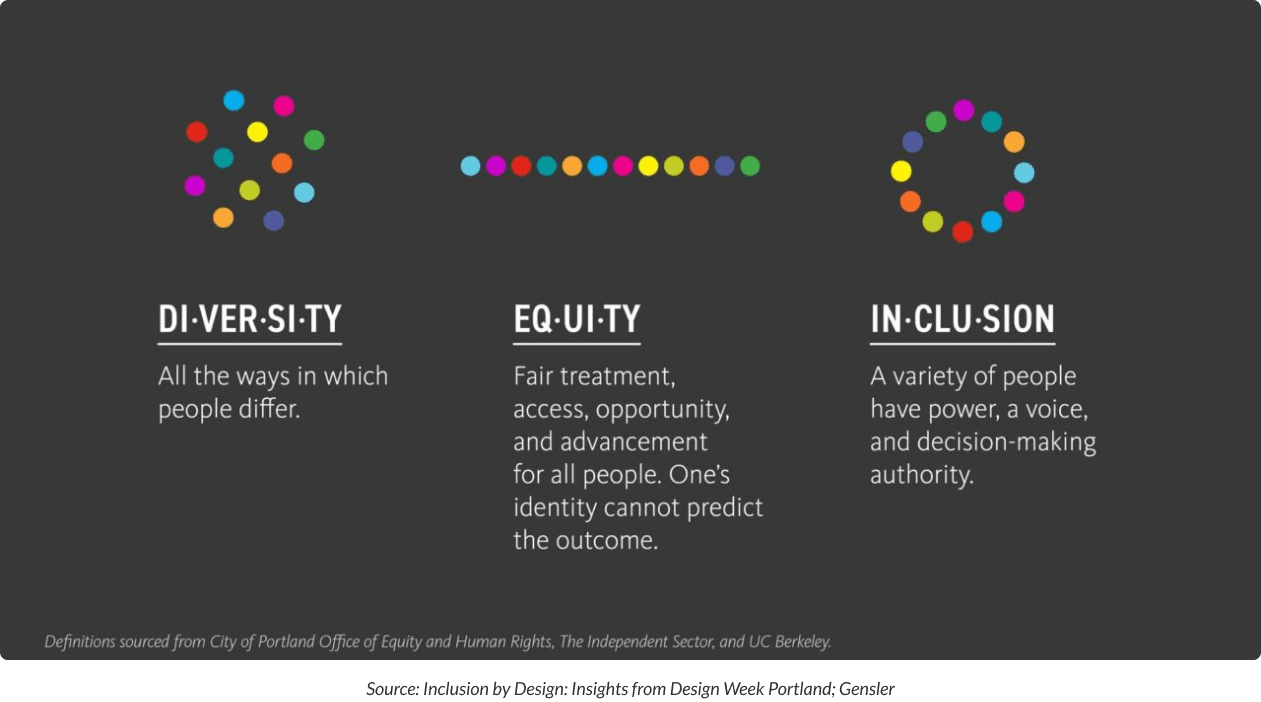
So what exactly is diversity, equity and inclusion?
Here’s a diagram that we found helpful in discerning between these words, and the values they each hold in our shared work of developing resources, supports and a thriving network of farms and farmers:
For Young Agrarians:
Diversity means celebrating the diversity of the farming and food systems community we are a part of. YA values the resilience that diversity of people, plants, pollinators, animals, crops and food systems bring.
Equity means applying an equity framework to how we support farmers, farms, our staff team, and the public. It requires us to examine how power and privilege shape our organization and the systems we work within. As an organization founded by white settler folks on unceded lands, we acknowledge that histories and ongoing practices of colonization continue to affect access, opportunity and outcomes. We commit to learning from this context and adjusting our practices to reduce barriers and develop equity. We do this by considering the whole story (Natasha Anderson Brass, Intergenerational Beauty) of how each of us has been impacted by the violence of colonisation and how each of us participates in and/or refuses economic systems that do not prioritize equity.
Inclusion means holding intentional spaces that uplift the voices of those who have been historically marginalized, who are equity-deserving.
As current or aspiring food growers, farmers, and consumers, we can work to continually grow our understanding of the systematic barriers that exist in food production and access to food. Participating in these learnings is a way to grow equity, diversity and inclusion for the future of our food systems. Together, we can actively dismantle the assumptions that create exclusions, barriers to access and isolation in the farming community.
We’ve gathered some resources that we have read, learned from, and continue to return to. We welcome you to be in touch with us as you visit these resources in your own time. Education is an ongoing process, and we hope that you will join us in learning, unlearning, and relearning what we know about who has access to growing food.
Below is a gathered list of farms and organizations and the resources that they have developed. Each is working on building diversity, equity and inclusion in relation to food-growing. We update this page with resources that we find helpful and that inform YA’s work. Keep checking back for updates to continue your learning journey with us.
EQUITY RESOURCES
START HERE
- Farmers for Climate Solutions (FCS) Equity Framework
- “The Equity Project learned directly from equity-deserving farmers in order to develop a framework and recommendations that could enhance current climate policy to better include and support equity-deserving farmers.”
- Farming in Canada: Who else do you have to thank?
- Pronouns 101
- A short guide on pronouns by Rock Steady Farm
- 8 Contributions of Black Farmers to Regenerative Agriculture
READ
- AgrAbility (Toolkit)
- Individuals with a disability who work in an agricultural setting face challenges that can impact their productivity, mental and physical health, and quality of life. The National AgrAbility Project provides general resources that address farming and ranching with a disability.
- Beyond Land Acknowledgements (Downloadable Toolkit/Guide)
- An online guide with actionable next steps for going beyond land acknowledgements.
- A good starting point for research about who’s land you live on is Native Land (native-land.ca) or Whose Land: (www.whose.land)
- Indigenous Agriculture and Agri-Food: The Path Forward (Full-length Report)
- Report by Farm Management Canada. “This report explores those needs across agricultural production, including aquaculture, Indigenous traditional and cultural harvesting, as well as those with on-farm processing and other related agriculture and agri-food activities.”
- Indigenous Writes: A Guide to First Nations, Métis & Inuit Issues in Canada by Chelsea Vowel (Book)
- Lost Harvests by Sarah Carter (Book)
- Meet 5 Of The Female Farmers Growing Our Food (Short Article)
- The Anti-Racist Farmers Market Toolkit
- “The Anti-Racist Farmers Market Toolkit was developed by a group of Black food systems leaders and market managers…to help offer ways for managers to put the concepts of anti-racism into practice and action within farmers markets. The work is intended to improve market experiences for Black, Indigenous, People of Color (BIPOC) and BIPOC communities.”
- The Color of Food: Stories of Race, Resilience and Farming by Natasha Bowens (Book)
- ‘They took our beads, it was a fair trade, get over it’: Settler colonial logics, racial hierarchies and material dominance in Canadian agriculture (Full-Length Report)
- “This research draws on studies of settler colonialism, racial hierarchy and othering to connect the ideological with the material forces of settler colonialism and show how material dominance is maintained through colonial logics and racially ordered narratives.”
- To free ourselves we must feed ourselves (Short Article)
- An opinion piece by Leah Penniman of Soul Fire Farm. This article is part of the Topical Collection: Agriculture, Food & Covid-19.
- “When you’re Black, you’re at greater risk of everything that sucks”: FoodShare’s Paul Taylor on the links between race and food insecurity (Short Article)
- Worker Zine! – Not Our Farm
- The worker zine is a guide to working on farms that was made by farm workers, for farm workers.
- Young Farmers Racial Equity Toolkit
- A toolkit that is broken down into 3 sections: 1) understanding racism and the importance of dismantling racism, 2) tools for having conversations about race, racism, equity, and justice with the community, 3) guidance on actions to take.
WATCH
- Audrey Logan – Indigenous Agriculture on the Prairies Before the Fur Trade (Video Recording)
- Teachings by elder Audrey Logan (Dehydration Nations) on Indigenous agriculture, its history, and building community through food. The original recording was part of the education offered to participants in the Young Agrarians Apprenticeship Program.
- BIPOC Perspectives in Food Production (Panel Discussion – Video Recording)
- 2020 Arrell Food Institute Summit – University of Guelph – Panel discussion moderated by Suman Roy (Meal Exchange), featuring Stepahnie Quinn-Davidson (Yukon Inter-Tribal Fish Commission), Bil Thorn (Sky Island Farm), Cheyenne Sundance (Sundance Harvest), Chris Ramsaroop (Justicia for Migrant Workers)
- Secret Alberta: The Former Life of Amber Valley (Short Doc)
- “Winner of the 2018 Canadian Screen Award for Excellence in Digital Storytelling; About 100 km North of Edmonton is Amber Valley, one of the first all-Black settlements in Canada. Arriving in 1909, the pioneers of this community battled the elements and racism to not only survive but thrive.”
- Miyo Mâmawi Atoskewin: Working together to Cultivate Soil Health on First Nations Lands (Video Recording)
- First Nations hold millions of acres of agricultural lands across the Canadian Prairies, most of it farmed by non-Indigenous farmers. In collaboration with First Nations, Dr. Melissa Arcand is investigating soil health on agricultural lands and reframing notions of agricultural land capability from an Indigenous perspective.
PROGRAMS
- THE EXCHANGE: Cultivating Diversity in Agriculture (National Farmers Union)
- Equity-deserving farmers can apply to join and receive support to pursue their training and mentoring goals in the context of THE EXCHANGE: Cultivating Diversity in Agriculture.
COURSES
- kinSHIFT (Online Workshops)
- kinSHIFT is an Indigenous-led initiative supporting settlers who are committed to building respectful relationships with Indigenous peoples and places. Their experiential, arts-based workshops and programs allow participants to learn, practice, ask questions, and make mistakes in a safer environment, all while building a foundation for engaging meaningfully with Indigenous peoples.
- Indigenous Canada (Online Course)
- “Indigenous Canada is a 12-lesson Massive Open Online Course (MOOC) from the Faculty of Native Studies that explores the different histories and contemporary perspectives of Indigenous peoples living in Canada.”
- Indigenous Traditional Food Systems (Online Module)
- Learn from Elders and Indigenous communities across Alberta. In this free online module, you will find out the importance of returning to a Traditional Food System, how communities are returning to it, and what role you can play in supporting Traditional Food Systems.
- 21 Day Racial Equity Habit Building Challenge (Webpage) from Food Solutions New England.
- It consists of daily email prompts and an online forum to explore and dismantle racism on all levels. The prompts take about 10-15 minutes a day to digest.
- Home on Native Land from RAVEN Trust (Online Course)
- A self-guided, online course about Indigenous Justice in Canada. Through a series of 10 videos, cartoons & lessons, you’ll take a walk down the back alley of history — and the frontlines of legal action.
ROLE MODELS
Below are a list of farms and organizations who are working on building diversity, equity inclusion in relation to food-growing. Their programs offer examples in the community of taking the above learnings and putting them into action.
- Black Creek Community Farm – Toronto, ON
- “Black Creek Community Farm increases access to healthy food in their community through their programming and food distribution projects.”
- Dehydration Nations – Winnepeg, MB – Treaty 1 Territory
- “This project is a grassroots, indigenous-led initiative which hopes to empower individuals and communities to harness the traditional method of food dehydration and pair it with nation-to-nation trade as a way of promoting food sovereignty in Treaty 1 territory and beyond.”
- They also have a Facebook Group which you can join here
- Fourth Sister Farm, Groundbirch, BC
- Ethical farming and wild harvesting on 160 acres of northern paradise. Their focus is to connect with other seed & land stewards, and encourage community members to strive for stronger food security without extraction. Run by Tiffany Traverse.
- Indigenous Climate Action
- “Indigenous Climate Action (ICA) is an Indigenous-led organization guided by a diverse group of Indigenous knowledge keepers, water protectors and land defenders from communities and regions across the country. We believe that Indigenous Peoples’ rights and knowledge systems are critical to developing solutions to the climate crisis and achieving climate justice.”
- Indigenous Food Systems Network
- The Indigenous Food Systems Network Website was developed by the Working Group on Indigenous Food Sovereignty to allow individuals and groups involved with Indigenous food related action, research, and policy reform to network and share relevant resources and information.
- Kara-kata Afrobeat Society – Vancouver, BC
- Kara-Kata Afrobeat Society, and Kara-Kata Afrobeat group, the musical arm, seek to harvest the powerful tool of music to promote peace, solidarity, education, and community between all people. They also have a new Africa Village Retreat Centre in Mission, BC where they will focus on getting back to nature, sustainable farming, and sharing Nigerian culture.
- Legacy Growers Collective – Vancouver, BC
- The Legacy Growers Collective is a network for Afro-Indigenous centered farming and gardening, outdoor education, and food security. The collective functions as a hub for African Diaspora Food Justice initiatives across metro Vancouver.
- Migrant Right Network
- The Migrant Rights Network is a cross-Canada alliance to combat racism and fight for migrant justice. We are a network of self-organized migrants including farmworkers, careworkers, international students, undocumented people as well as allies.
- NFU
- The National Farmers Union is Canada’s national farm organization committed to family farms. Promoting agroecology and food sovereignty for 50+ years, the NFU does not waver in our vision for farmers, eaters, and the earth, embedded in social and economic justice in Canada and internationally. They also include advisory committees for different equity deserving farmers:
- Indigenous Solidarity Working Group
- BIPOC Advisory Committee
- Women’s Advisory Committee
- Not Our Farm
- Not Our Farm is an organization that amplifies the voices of farm workers and works to support and celebrate career farmers working on farms that are not their own.
- RAMA – Radical Action with Migrants in Agriculture – BC
- RAMA is a migrant justice collective that advocates for Latin American and Caribbean migrant farm workers in the unceded Syilx and Secwepemc territories of the Okanagan Valley. We work to build radically inclusive and more socially just communities by engaging in political advocacy, accompaniment, direct support work, public awareness campaigns, and the documentation of workers’ conditions and experiences. We are a volunteer-run, not-for-profit group.
- RAVEN
- RAVEN is a registered charity with a mission to raise funds for Indigenous People’s access to justice. Guided by some of the most brilliant legal advisors in the country, we work to enshrine environmental justice for all. The law is clearly on the side of Indigenous peoples: their victories protect us all.
- Rock Steady Farm – Millerton, NY (USA)
- “Rock Steady is a queer* owned and operated cooperative vegetable farm rooted in social justice, food access and farmer training.” They run a program called POLLINATE! which is “a paid training program for aspiring and beginner queer and trans* farmers interested in cooperative farm business models that center equitable food access”
- Shade of Miti – Mississauga, ON
- A food and climate justice organization for youth, newcomers, communities of colour, LGBTQ+, ally and accomplice communities in Mississauga. This organization is for communities that experience systemic oppression from our food and climate systems, allies and accomplices. We envision sustainable food systems in Mississauga that are rooted in sovereignty and justice and not threatened by climate change.
- Sole Food Street Farms – Vancouver, BC
- “Sole Food transforms vacant urban land into street farms that grow artisan quality fruits and vegetables. Our mission is to empower individuals with limited resources by providing jobs, agricultural training and inclusion in a supportive community of farmers and food lovers.”
- Sorauren Farmers’ Market – Toronto, ON
- This market runs a BIPOC New Farmer Initiative which provides a subsidized farmers’s market spot plus mentorship from BIPOC mentors.
- Soul Fire Farm – Grafton, NY (USA)
- Soul Fire Farm is an Afro-Indigenous centered community farm committed to uprooting racism and seeding sovereignty in the food system. They bring diverse communities together to share skills on sustainable agriculture, natural building, spiritual activism, health, and environmental justice.
- Sundance Harvest – Toronto, ON
- CSA, flower, fruit and vegetable farm and living wage employer.
- Cheyenne Sundance, the Farm Director, has initiated many projects to help make farming and food accessible. One project is Sundance Commons which is a non-profit that provides the tools, guidance, and land access for new farmers who face barriers to entry in the agricultural sector and land access more broadly. Other projects include: A free urban agriculture registered not-profit program called Growing in the Margins, which nurtures and grows the farm projects of BIPOC youth from seed to harvest. They also started a program called Liberating Lawns, “a yard sharing project of Sundance Harvest seeking to match prospective BIPOC youth food growers with landholders so that their lawns can be liberated!”
- Sunny Boy Farm – Toronto, ON
- Sunny Boy Farm was founded by Soniel Gordon, to reclaim the community-based farming lifestyle and it’s benefits. We aim to address some of the growing socio-economic issues that plague our communities, by providing employment opportunities, offering skill and personal development training, educational and mental health workshops. Also offers a CSA sponsorship program for families in need.
- Tea Creek – Kitwanga, BC
- Tea Creek is an Indigenous-led, culturally-safe, land-based Indigenous food sovereignty and trades training initiative. They are bringing training and mentorship to 1000+ people per year, while giving away over 20,000 pounds of food to the community.
- The Cabbage Patch- Puslinch, ON
- The Cabbage Patch is run by Felix, a young fist generation farmer passionate about tacking food security sustainability.
- Treaty Land Sharing Network – Saskatchewan – Treaty 4 Territory
- “The Treaty Land Sharing Network connects farmers and other landholders with First Nations and Métis people needing safe access to land to practice their way of life. We are committed to honouring the Spirit and Intent of Treaties by sharing the land for mutual benefit.”
- Queer Farmer Network – USA
- “We are a dispersed network of current, lapsed, and aspiring farmers, gardeners, growers, herbalists, tenders of land, food revolutionaries, and more spread across the so-called USA. The QFN was formed in 2018 by a group of friends & comrades in the upper midwest to build community among queer farmers and to reflect on and interrupt racist, capitalist, and heteropatriarchal legacies in Agriculture.”
We hope to further diversity, equity, and inclusion in farming. This page will continually be updated with resources in the community that we find helpful. Keep checking back for updates and continue your learning journey with us.
Want to share your learnings or have any suggestions? Email network@youngagrarians.org.