
British Columbia Business Business Mentorship Network Canada Farmer Profiles Flower Poultry - Layers Vegetable
Business Mentorship Network – Annie’s Family Farm
Posted on April 1, 2026

 Filter by Popular Categories
Posted on April 1, 2026
“Looking back, our younger selves might be surprised that we ended up farming, but it also somehow makes sense. We often describe ourselves as “returning generation” farmers because both of our families have roots in agriculture, even though neither of us grew up farming ourselves. We love that farming brings together many of the things we value — creativity, entrepreneurship, problem-solving, and care for land and community.“
Young Agrarians is celebrating the twelfth year of the Business Mentorship Network (BMN) program in BC and the fourth year of the BMN in the Prairies! The BMN offers a year-long farm business mentorship to a diverse array of new and young farmers. Through one-on-one mentorship, peer networks, and online workshops, new farmers develop the skills necessary to operate ecologically sustainable and financially viable farm businesses.
Applications for mentees open in October 2026. Click below to be notified when applications open!
Mentor applications are accepted year-round. Check out the Business Mentorship Network page for more information!
Meet a mentee from the current cohort and learn about their farm and why they joined the Business Mentorship Network. Want more? Head over to our BMN Blog for more mentorship stories.
Our names are John Morton (he/him) and Telia Hsieh (they/them), and we operate Annie’s Family Farm in the North Cowichan, Vancouver Island, BC on the unceded traditional territory of the Quw’utsun Peoples and the broader Coast Salish Nations. Our mentors are Robin Tunnicliffe and Sasha Kubicek of Sea Bluff Farm.
What type of business structure is your farm?
Annie’s Family Farm operates as a general partnership between the two of us.
How much land is under production on your farm and what do you produce?
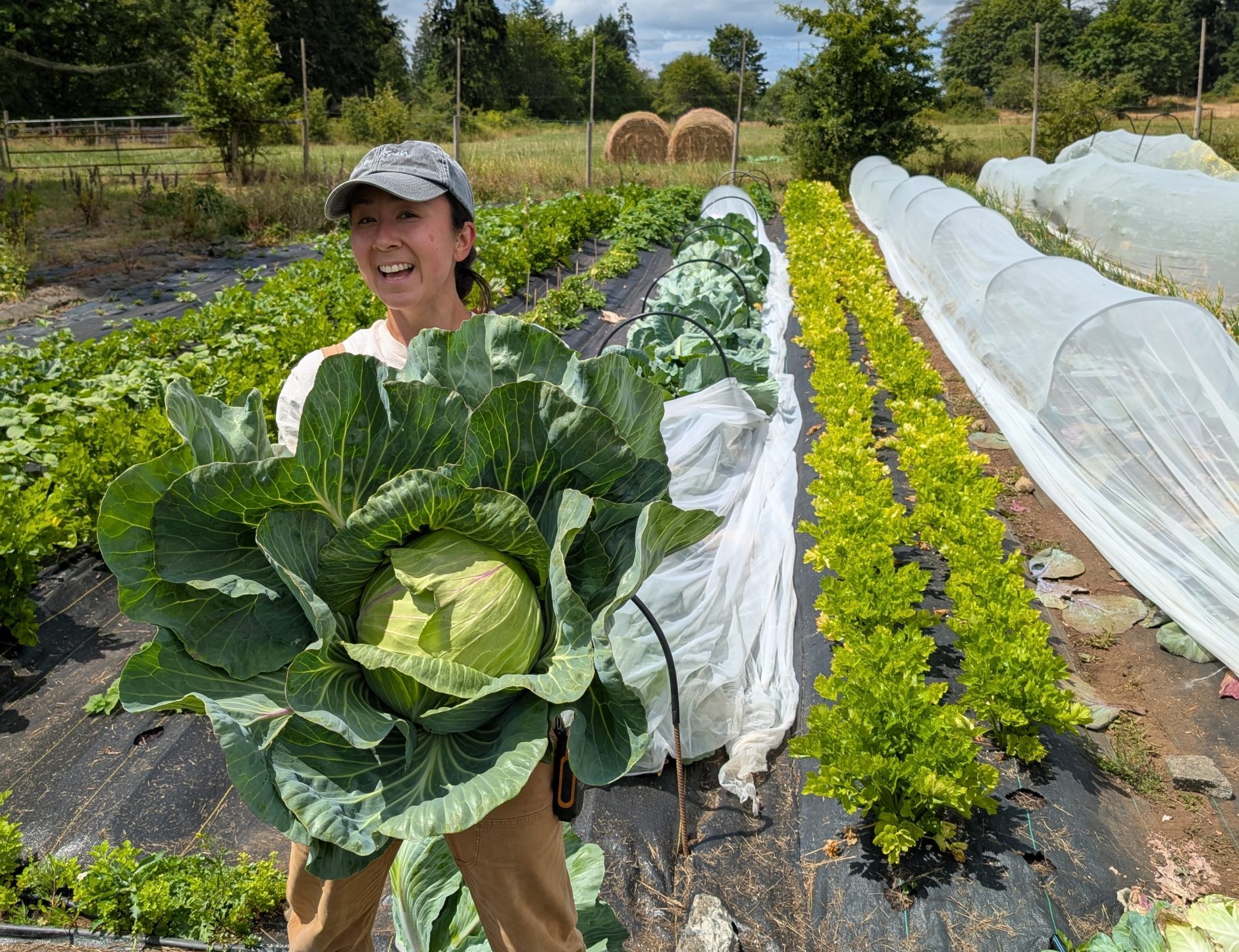
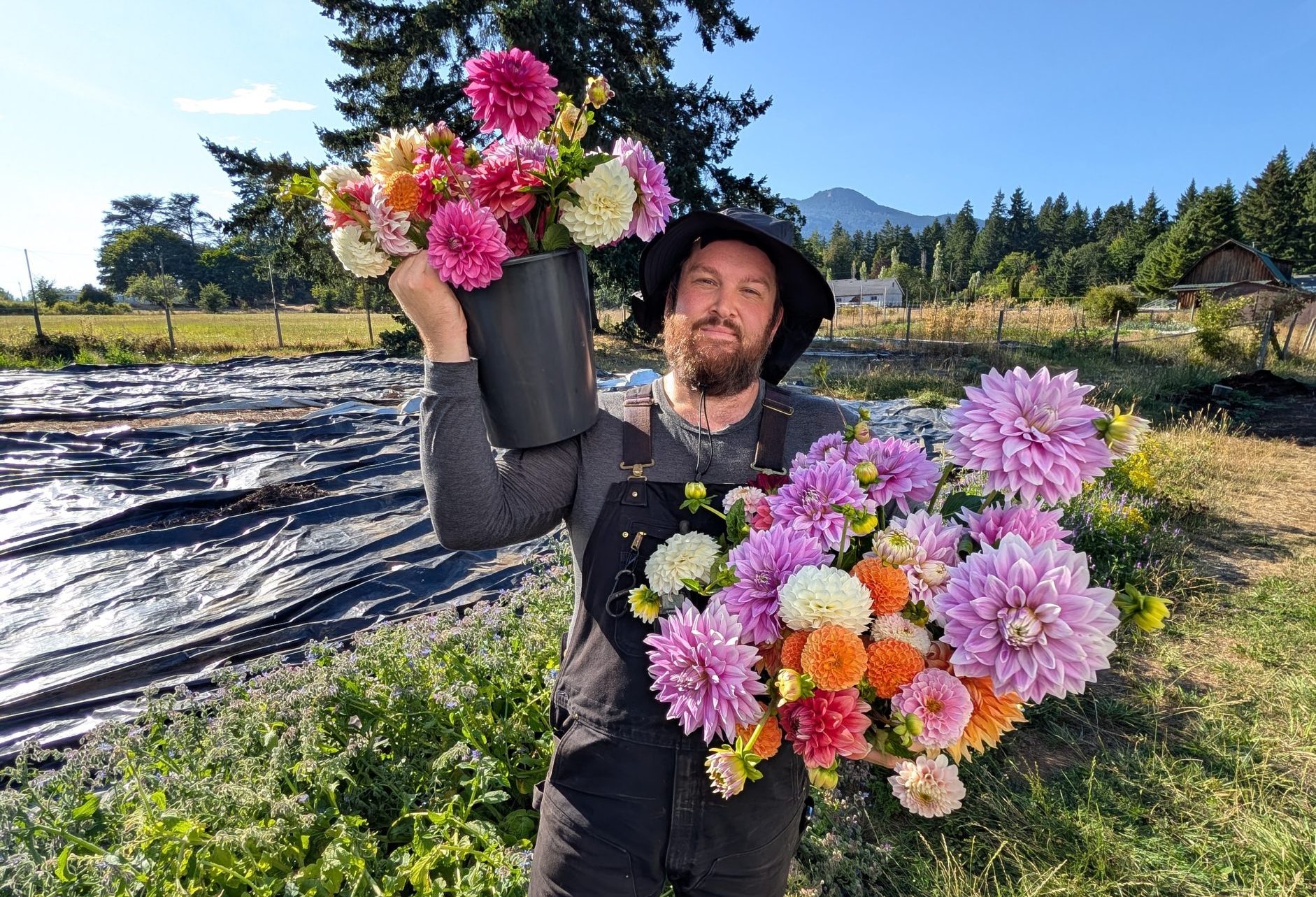
We are currently cultivating around one acre of production, with plans to expand to around 2.5–3 acres over the next few years. We grow a mix of vegetables, cut flowers, berries, and eggs. We are currently an organic farm in transition and will be certified organic on March 28, 2026. Flower production has become an important part of the farm, both for bouquets and as a way of drawing people to the farm shop, where they often discover our vegetables and eggs as well.
What kind of land agreement do you have?
We were fortunate to be able to purchase our farm property in 2024. The land had previously been farmed by two other businesses, including Dancing Dandelions Farms and before that Trees Plus Nursery. We’ve spent a lot of time connecting with the previous farmers to learn about the history of the land, the infrastructure they built, and the lessons they learned. That knowledge has been incredibly valuable as we continue the evolution of the farm.
Did you access any financing to buy land or start your farm business?
Getting started required a mix of resources. Purchasing the property involved a traditional mortgage along with personal savings, including proceeds from John selling his digital marketing business in 2019, which helped provide the down payment for the farm, as well as money left to John and his sister by their mum, Annie, who passed away in 2020, who the farm is named after.
As part of our planning, we knew the mortgage approval process would be easier if we both had stable full-time work. We also were not entirely sure where our farm would end up being (we researched areas ranging from the Okanagan to Vancouver Island) but we knew it would likely be somewhere in British Columbia and that we would need remote work that allowed us to keep our income without being tied to one location.
At the time, John was freelancing and Telia was working at UBC, so we both began looking for full-time remote positions. Once we had secured those roles, we then needed to complete our probation periods (Telia’s was six months) before we could apply for a mortgage, find out what we were pre-approved for, and begin our property search.
Building the farm business itself has largely been self-funded so far through savings and reinvesting farm income.
Telia continues to work full-time off the farm during the day while helping build Annie’s Family Farm in the evenings and on weekends. John has since returned to freelance work, which gives him a somewhat more flexible schedule and allows him to take on more of the day-to-day farm operations. Maintaining off-farm income has provided important financial stability and benefits, while also allowing us to invest in the farm’s infrastructure gradually and scale the business in a thoughtful and sustainable way.
What inspired you to get into farming? Would your younger self be surprised by where you are now?
Before the farm, John ran a digital marketing agency, and Telia worked in various spaces between community support work, marketing, and communications. Farming wasn’t something either of us initially set out to do.
One of the experiences that really changed our perspective happened while we were travelling in Italy. We decided to try WWOOFing as an interesting travel experience and ended up spending time on a small farm in Sardinia with Cristina and Fabrizio. They lived a very different rhythm of life than what we were used to — growing food, sharing simple and fresh meals with family and friends (both new and old), and welcoming people from around the world into their home and farm. Seeing how food, land, and community could all be connected in such a simple and meaningful way left a lasting impression on us.
When we returned home, we started small. At first it was just two stand-up planters where we experimented with growing a few vegetables. That slowly grew into a backyard garden that started as an overgrown blackberry patch. Telia cleared it and built beds, and over time we began growing enough vegetables to share with friends, family, neighbours, and coworkers.
Looking back, our younger selves might be surprised that we ended up farming, but it also somehow makes sense. We often describe ourselves as “returning generation” farmers because both of our families have roots in agriculture, even though neither of us grew up farming ourselves. We love that farming brings together many of the things we value — creativity, entrepreneurship, problem-solving, and care for land and community.
How did you learn how to farm?
A big part of our learning has come from hands-on experience and mentorship. After our initial experience WWOOFing in Sardinia, we continued seeking out opportunities to learn directly from farmers.
We volunteered on additional farms through WWOOF and other connections, and Telia spent time learning with Noah, Elisabeth, and Fin at Jollity Farm on Thetis Island, which was an incredibly formative experience.
Telia also took the Market Gardener Institute Masterclass to better understand both the production and business side of small-scale farming.
We’ve found scaling up to be a steep learning curve, but we love it and and we’re constantly learning something new!
What types of ecological farm practices do you engage in?
Our farm is currently in transition to Organic Year 3 status under the BCCO program requirements. We focus on soil health, compost-based fertility, crop rotation, and biodiversity. We work to build resilient systems that support pollinators, beneficial insects, and healthy soil biology.
Diversification is also an important resilience strategy for us. Growing vegetables, flowers, berries, and raising chickens help reduce risk by relying on a single crop, and helps to support a healthier farm ecosystem overall. We’re also setting up an agritourism component to help with slower months on the farm and build awareness and provide educational opportunities about food systems and agriculture much like how we first experienced by WWOOFing as well as hopefully assist in allowing us to transition more into fulltime farming.
Why did you apply for business mentorship?
Farming requires many different skills, from production to business planning to marketing and infrastructure development. We applied to the Young Agrarians mentorship program because we wanted guidance from someone who had already navigated those challenges successfully.
Having a mentor has helped us think more strategically about infrastructure, crop planning, and long-term business sustainability. The reassurance of experienced farmers in the community has also helped build our confidence.
Although we bring some business, marketing, and operations skills to the table, we are very new to farming compared to many of our peers, so we felt incredibly lucky to be paired with a mentor who is a master, especially in organic growing. We had actually purchased Robin’s book All the Dirt earlier this year before knowing she would become our mentor!
What are your primary business goals for the season?
Our biggest goal this season is improving our post-harvest infrastructure by building a proper wash/pack station and cold storage system. Right now a lot of our vegetable washing still happens with a hose and some improvised setups, which isn’t very efficient. Upgrading this system will allow us to scale production, reduce losses, and make the farm more sustainable to operate. It will also provide us with cold storage that can accommodate both warmer crops like nightshades and colder storage crops like brassicas.
We’re also continuing to develop our farm shop so more customers can purchase directly from the farm, which helps reduce the time and energy spent transporting products off-farm to sell.
Looking ahead, we’re also beginning to explore agritourism opportunities such as farm tours, workshops, and long-table dinners as another way to diversify the farm business.
What is the greatest challenge you face as a new farmer?
One of the biggest challenges is the need for significant upfront investment in infrastructure while the farm itself is still developing. Things like irrigation, fencing, cooling, and equipment are all essential for operating a farm efficiently, but they require capital before the farm is able to generate enough income to support those costs on its own.
For us, maintaining off-farm income has been an important part of making that possible. Having stable work helps provide the financial stability needed to invest in the farm’s infrastructure and gradually scale the business.
At the same time, balancing off-farm work with building the farm can be challenging. Much of the farm work happens in the early mornings, evenings, and weekends, so it often feels like we’re working multiple full time jobs. Learning how to divide time and energy between those responsibilities while still moving the farm forward and not burning out is something we’re constantly working to navigate.
In short, finding that balance between investing in the farm while also maintaining the income needed to support it, is probably one of the most complex parts of starting our farm business.
What business tools or resources could you not live without?
Being new to farming and new to the community of Duncan, the Cowichan Agricultural Society has been a huge resource in helping us connect with our peers, resources and opportunities that would have taken so much longer to facilitate and we have found the community has been so genius and supportive, we feel extremely lucky! The Market Gardener Institute course was also very helpful as someone new to farming and covers a wide range of business and organization matters on top of optimal growing conditions, we find ourselves revisiting these resources. Cow-Op Online Farmers Market. The Young Agrarians newsletters, network and community events. We also rely on simple tools like spreadsheets, crop planning software, and shared documents to manage the complexity of the farm. Our organic certification body (previously IOPA and now NOOA soon to be OCERT) has also provided incredible templates for us as a solid baseline.
But honestly, the most valuable resource has been conversations with other farmers.
How can we find out more about you and your farm?
You can find us online at:
Website: https://anniesfamilyfarm.com
Instagram & Facebook: @anniesfamilyfarm
Our products are available locally through the Cowichan Valley Cow-Op and directly at our on-farm farm shop in North Cowichan… just down the street from the Walmart!