So you’ve done your testing and your soil results are in from the lab, now what?
If it’s your first time looking at your soil results from a lab it may be a bit intimidating to interpret what all the numbers mean.
Some tests may provide trace elements as well as the big three (N,P,K) along with soil organic matter, electrical conductivity and pH.
For the cost of it, I don’t mind paying for more detailed tests. More known variables allow for more accurate predictions in crop yields and needs.

Soil reports will often list your nutrients in pounds per acre or PPM (parts per million).
The formula lbs/acre = ppm x 2 can be used to convert between the two numbers.
If we look at the report above, K (Potassium) is listed at 762ppm. To know how many pounds of K are in the soil on one acre, we multiply the ppm x 2 and we get 1524 lbs per acre of K.
1524 lbs of K is at about twice as much as the recommended amounts needed in the soil for something like potatoes which consume a lot of K. Based on this, no application of K would be needed and may not be for a couple years.
As we can see the Organic Matter (OM) content is at 25% (which is fairly high) and all nutrient levels are high, we can tell that this test was done after an application of manure and bedding material.
To calculate your fertilizer needs, you simply look at your suggested ppm of the specific nutrient for the specific crop (often you can find this info in university research and extension papers) and compare it to your soil test results.
Example: if your fertility report has a potassium value of 280 lbs/acre and you plan to grow vegetables that require 340 lbs/acre, then you would apply based on the formula below:

Now you know how many pounds of potassium you need to amend your soil but how many pounds of actual potassium are in your bags of fertilizer?
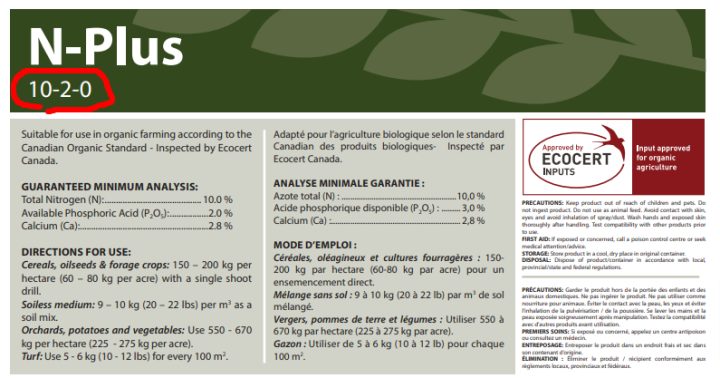
I typically use sulphate of potassium (potash) for my potassium needs in our organic operation. Bags are typically listed as 0-0-50 meaning they are heavy on the potassium so you don’t need too many bags.
If each bag weighs 50lbs then we can expect 25lbs to be K2O or 20.75lbs of K (Potassium) using our conversion factor of .83.
If we need 60 lbs of Potassium (K) according to our formula above based on our soil test results then we need 2.8 bags.
50 lbs bag x .5 x .83=20.75lbs of K per bag
60lbs of K required / 20.75lbs of K per bag
= 2.8bags
Electrical Conductivity and salty situations
Soil electrical conductivity (EC) is a measure of the amount of salts in soil (salinity of soil). It is an excellent indicator of nutrient availability and loss, soil texture, and available water capacity.
Often in your soil tests from labs they will let you know when your EC is too high meaning too much salts/fertilizers which can become toxic to your plants and also a hazard to the environment. In greenhouses that don’t receive periodic rain storms or snow to help push salts back into the soil profile, salts can become crystallized in the surface of the soil from evaporation making a poor place for seeds and transplants to start their life.


 Filter by Popular Categories